


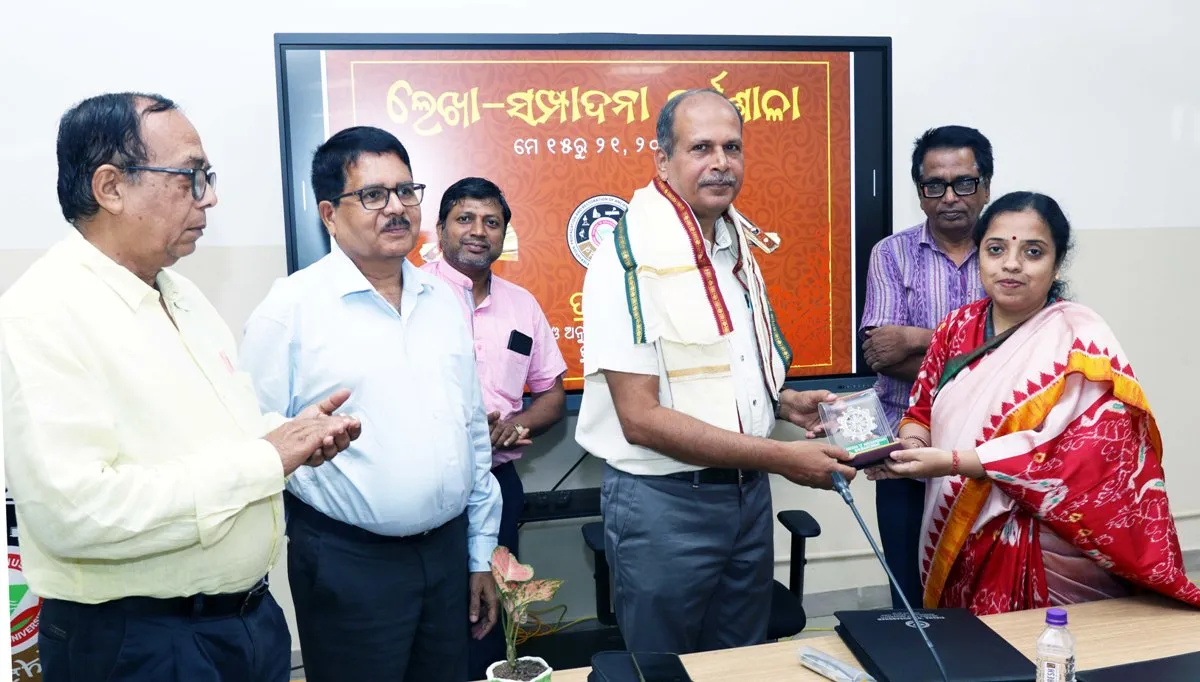
Bhubaneswar, May 16: Eminent scholar of Indian epigraphy and paleography, Dr. Subrat Kumar Acharya on Friday stressed the need for focusing on text editing as the country had a vast treasure of ancient texts.
India’s literary tradition, particularly the Sanskrit epics, needed to be explored as barely 20 per cent of the available texts had been edited till now while the rest were yet to be explored, Dr. Acharya said while speaking as the chief guest at the inaugural function of a week-long workshop on Text Editing held at the SOA Deemed to be University here.
The workshop, being attended by 41 researchers, has been organized by the SOA Centre for Propagation, Preservation and Restoration of Ancient Culture and Heritage of India (PPRACHIN).
Dr. Acharya said if the manuscripts were edited it would greatly benefit the researchers. “Researchers are also not evincing interest in text editing because it is a difficult task and no university was also focusing on this aspect though Odisha has plenty of ancient literature,” he said.
Four PPRACHIN experts in the domain—Prof. Jagannath Das, Prof. Gouranga Charan Das, Prof. Pradipta Kumar Panda and Prof. Santosh Kumar Ratha, would be imparting training to the researchers attending the workshop. Prof. Gayatribala Panda, Head of PPRACHIN, outlined the objective of the workshop.
Dr. Acharya said when the European historians set foot in India, they were under the impression that the country did not have a history or any culture. “The first historians on India were imperial historians who chronicled what they knew in the 18th and early 19th century,” he said.
It was Sir William Jones, a philologist, who set up the Asiatic Society of Bengal in 1784 to set the ball rolling. He started collecting ancient texts and inscriptions and was joined by researcher Charles Wilkins. They took the help of local pundits to delve into the texts.
“By 1808, the duo rendered Kalidasa’s Shakuntala into English and introduced the richness of Sanskrit to the Anglo-Indian literature. Gradually, the Britishers realised that India had a rich literary tradition,” Dr. Acharya said adding subsequently German and English scholars took much interest in Indian literature.
Prof. Panda discussed about the activities of PPRACHIN informing that it was engaged in editing the Sarola Das Mahabharatha and had already published several volumes of the epic. It had also digitalized more than seven lakh pages of ancient literature, she said.
The program was also addressed by Prof. Gouranga Charan Das who said that it was the second such workshop to be organised by PPRACHIN. He urged the participating researchers to take keen interest in the sessions and learn as much as they could. Dr. Nihar Ranjan Mishra, Associate Professor, Jeeban Kumar Panda, Bibhuti Prasad Sahu and Sambit Patnaik were also present.