

.webp)

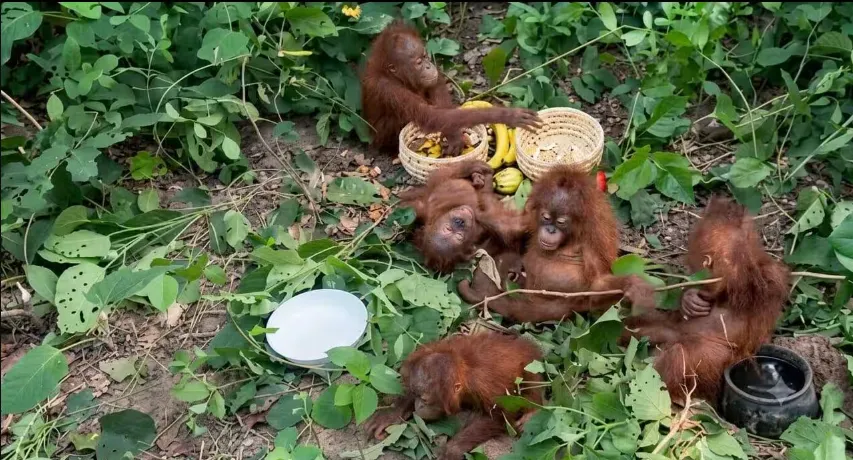
Balasore, Sept 9: The discovery of five orangutan cubs in a casuarina forest in Balasore has triggered widespread speculation over how the rare animals reached the region. Authorities are yet to determine whether the cubs somehow arrived from a humid natural habitat or were abandoned after a wildlife smuggling operation was disrupted.
Orangutans are native to the tropical rainforests of Southeast Asia, particularly the islands of Borneo and Sumatra. Their populations have been declining rapidly due to habitat loss, hunting and illegal wildlife trafficking, making them one of the world's most endangered groups of great apes.
Known for their reddish-orange fur and high intelligence, orangutans are the largest arboreal mammals in the world. Their behaviour and physical characteristics have several similarities with humans, and their DNA is estimated to be about 97 per cent similar to that of humans. They can live for several decades and typically build nests high in trees.
Also Read:“International link suspected”: Minister on five Orangutans found in Odisha
Unlike many other primates, orangutans are generally not highly social animals and are often found living largely solitary lives. However, mother orangutans maintain an exceptionally strong bond with their offspring. A mother may care for a young orangutan for seven to eight years, making the presence of five cubs, all reportedly less than a year old, particularly significant.
Given their age, it is highly unlikely that the cubs were voluntarily separated from their mothers. A senior Forest Department official said there is no natural corridor connecting Indonesia with West Bengal or Balasore that could have allowed the animals to reach India. Crossing thousands of kilometres of sea naturally would also be virtually impossible for such young animals.
Investigators have reportedly recovered several pairs of gloves from the spot where the cubs were found. Suspicious movements in the surrounding area have also raised questions about possible human involvement. These circumstances have strengthened the suspicion that the orangutans may have been illegally transported and subsequently abandoned.
Another possible angle being examined is the maritime route between Indonesia and India. Indonesia is one of the world's major palm oil-producing countries, and large-scale deforestation for palm oil plantations has severely affected orangutan habitats. India, meanwhile, is a major importer of palm oil, with large quantities transported by sea to Indian ports.
Forest officials are reportedly examining whether the cubs could have been smuggled aboard a cargo vessel carrying palm oil or other goods from Indonesia. However, no conclusive evidence has yet emerged to establish how the animals reached Balasore.
📲Follow our WhatsApp Channel for the latest news, breaking updates, and important headlines. Stay connected with us for more updates!
The recovery of five highly vulnerable orangutan cubs in an Indian forest has therefore opened up a larger investigation into the possibility of an international wildlife trafficking network. Authorities are expected to examine the animals' health, genetic origin, travel route and other evidence to determine where they came from and who brought them to Balasore.
.webp)