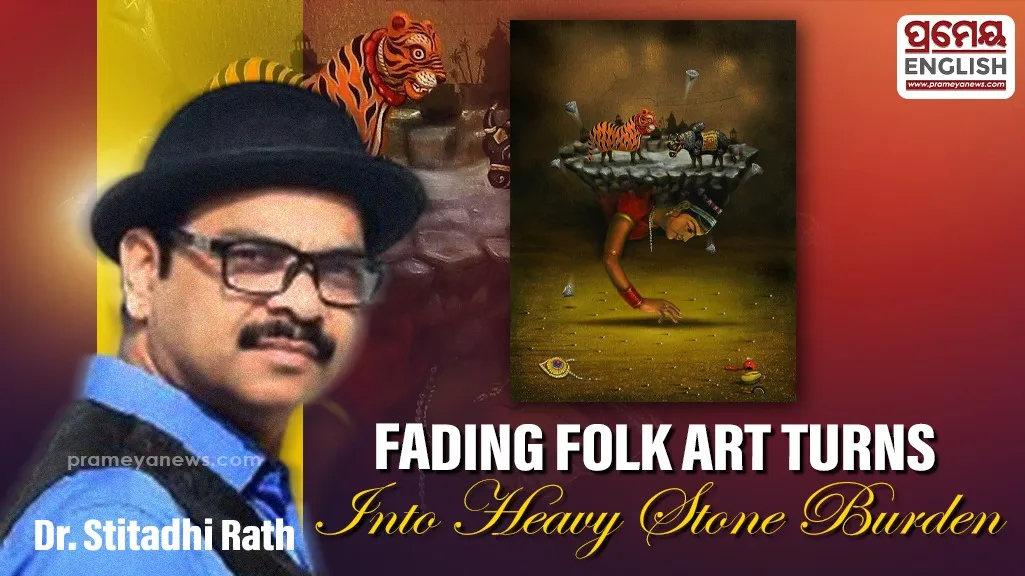
Context Narrative: Fading Folk Art Turns Into Heavy Stone Burden
Folk traditions across the globe face a quiet, existential crisis as modernity reshapes human priorities. This evocative canvas captures the agonizing weight of cultural preservation in the Ganjam district of Odisha, India, transforming a regional struggle into a universal testament to human resilience. The composition positions the folk artist as a tragic atlas, physically upended by the crushing gravity of her own heritage. Balancing a massive stone platform on her back, she reaches toward an empty void, embodying the desperate search for economic survival when local patronage dries up.
Above her, the vivid tiger and bull masks of the Pashumukha animal dance stand ready for a performance that may never come. The musician has vanished into the workforce, leaving behind a solitary turban and an silent instrument on the soil. This visual abandonment speaks to a global phenomenon where economic necessity forces indigenous performers to desert their crafts. By rendering the crumbling fragments of this fading dance as falling diamonds, the artist challenges international audiences to reassess what society deems valuable. The scattered pearls on the floor represent the shattered, yet still brilliant, remains of an ancient identity waiting for revival.
This image forces a confrontation with global power dynamics that prioritize mass industrialization over indigenous art forms. When a community loses its folk dances, it loses its historical memory. The inverted woman represents millions of traditional keepers of culture worldwide who are bent double under the paradox of carrying a priceless legacy that cannot feed them. Her extended hand is not just a gesture of despair, but an urgent, cross-cultural appeal to catch these falling diamonds before they disappear into the dirt forever. Cultural heritage is often romanticized, but here it is exposed as a beautifully heavy burden born by the marginalized. The artwork demands a global shift in patronage, proving that saving a community's art is essential to preserving human diversity.
Structural Audit
- Medium: Acrylic or oil on canvas with a textured finish.
- Color Palette: Dominated by earthy ochres, deep browns, and muted gold on the ground and background. Piercing contrast provided by the vibrant orange of the tiger mask and the deep black-and-gold tones of the bull mask.
- Composition: Vertical, surrealist alignment. A floating, heavy stone slab divides the canvas into upper and lower spheres. The lower sphere shows an inverted, traditional folk performer reaching down, while the upper platform holds folk artifacts against a silhouetted temple horizon.
- Central Figures: A stylized tiger mask and a decorated bull mask (Pashumukha) facing each other on a rocky precipice. Below them, a woman in traditional red attire and bangles hangs inverted, her hand stretched toward the ground.
- Symbolic Elements: Falling diamonds and scattered pearls/beads dotting the ground. A discarded turban, a traditional musical instrument, a sickle, and an ornate hair ornament lie abandoned at the bottom.


.webp)

.webp)