
.webp)


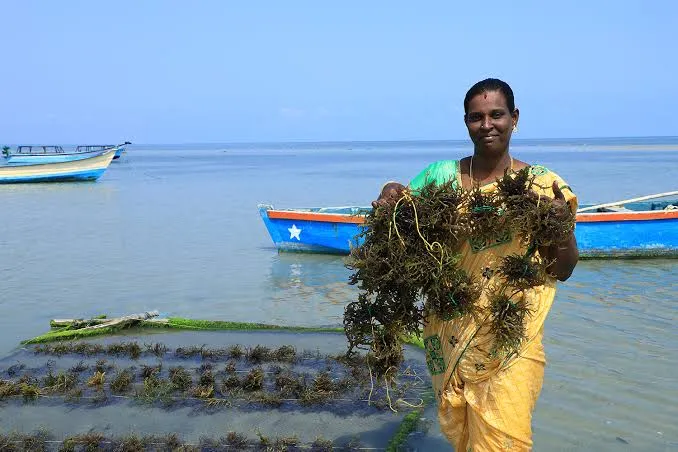
Karaikal, Sept 4: Seaweed farming is emerging as a promising new livelihood option for women fishers in Puducherry’s Karaikal region, where marine red algae is being cultivated and processed into organic fertiliser.
Around 4 kg of Kappaphycus alvarezii seed material can yield nearly 20 kg of seaweed, with harvesting carried out within 30 to 35 days of planting in the sea. Each harvest cycle generates an income of around Rs 28,000 to Rs 30,000.
The initiative currently involves seven women, while another 11 women from nearby areas are also engaged in seaweed cultivation. After harvest, the seaweed is sent directly to processing units, where around 3 kg of algae is used to produce one litre of liquid fertiliser.
The fresh extract-based seaweed fertiliser acts as a bio-stimulant in agriculture and horticulture. Its application on crops such as paddy, wheat, ragi, pulses, cotton, sugarcane and vegetables is reported to increase yields by around 15% to 30%.
Rich in potassium, magnesium, micronutrients and natural plant hormones, the seaweed-based fertiliser can also help reduce the use of chemical fertilisers, particularly urea and potash, by around 20% to 25%, potentially lowering cultivation costs.
The organic formulation is also considered beneficial for improving plant resilience against drought, excessive heat and saline soil conditions, making it useful for sustainable farming practices.
According to Fisheries Inspector Rajasekhar, the projects underway at Pattinamcherry and Karukkalacherry have delivered encouraging results and emerged as an example of community-driven coastal enterprise development.
The seaweed-based model has applications beyond agriculture as well. Its extracted components are used in the cosmetics and pharmaceutical sectors, while residual organic matter can be processed into nutrient-rich animal feed.
The initiative has also attracted attention from the media. A media delegation from Odisha, organised by the Press Information Bureau (PIB), Bhubaneswar, visited the Karaikal cluster to observe seaweed cultivation and processing activities. The journalists visited the seaweed cultivation facility and nearby farms to understand the project and its impact on local livelihoods.
The delegation was led by PIB Deputy Director Manoj Kumar Jali and Media and Communication Officer Swadhin Shakti Prasad.
The Karaikal experience highlights how seaweed farming can create alternative income opportunities for coastal communities while supporting organic and sustainable agriculture.
.webp)