
.webp)


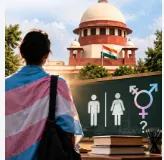
New Delhi, October 23: The Supreme Court has sought an explanation from the Delhi government on the legal basis for issuing separate vacancy notifications for male and female teachers and the measures proposed to ensure the inclusion of transgender candidates in public employment.
A bench comprising Justices JB Pardiwala and K Vinod Chandran, in an order dated October 16, framed six questions in petitions filed by Jane Kaushik and Praveen Singh. The court directed the Delhi government to submit affidavits addressing the issues within 15 days.
“The issue before us pertains to the non-inclusion of third gender in the notifications for vacancies issued by the respondent State,” the bench observed.
The apex court asked the government to specify the recruitment rules governing notifications issued by the Delhi Subordinate Services Selection Board (DSSSB) and clarify whether any constitutional provision, statute or service rule mandates the advertisement of teaching vacancies separately for men and women.
If no such legal requirement exists, the government has been asked to explain the rationale behind the gender-based classification.
The bench also sought clarification on whether the authorities intend to include transgender candidates in DSSSB recruitment notifications and, if so, what measures would be adopted to facilitate their participation in public employment.
In Praveen Singh’s petition, which concerns age relaxation for transgender candidates, the Supreme Court questioned why the Delhi High Court had not considered exercising its powers under Rule 12 of the Delhi High Court Establishment (Appointment and Conditions of Service) Rules, 1972, to grant relaxation in view of the “socio-economic discrimination” faced by the transgender community.
The Supreme Court has scheduled the next hearing in the matter for November 19.
In April, the apex court had observed that the advisory committee constituted to examine systemic issues relating to transgender rights lacked adjudicatory powers. It had also prima facie questioned the Delhi High Court’s decision to direct Kaushik to approach the committee rather than adjudicate her petition.
The latest proceedings bring the focus back to the legal and administrative barriers faced by transgender persons in accessing equal opportunities in public employment.
.webp)