


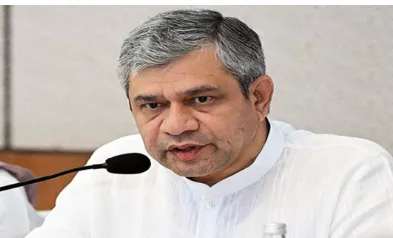
New Delhi, April 29:Union Minister for Railways Ashwini Vaishnaw will flag off the extended Srinagar-Katra Vande Bharat Express service from Jammu Tawi Railway Station tomorrow, i.e. on 30th April 2026.
The train, which previously operated from Srinagar up to Shri Mata Vaishno Devi Katra, will now run all the way to Jammu Tawi, bringing the country's most modern train directly to J&K's largest city and railway hub.
Following the flag-off, the Union Minister will subsequently inspect two of the most remarkable engineering structures on the Udhampur-Srinagar-Baramulla Rail Link (USBRL), the Anji Bridge and the Chenab Bridge.
When Prime Minister Narendra Modi flagged off the Katra–Srinagar Vande Bharat Express on 6th June 2025, the train ran with 8 coaches. Since then, the train has consistently been running at full capacity, with an overwhelming response from passengers. The decision to augment the rake to 20 coaches is a direct response to that demand, more than doubling the train's seating capacity at a stroke, and significantly easing the pressure on reservations and waitlists, particularly during peak pilgrimage and tourist seasons.
For pilgrims who have watched seats sell out days in advance, for tourists planning a trip to the Valley, and for locals who rely on this service for everyday travel, the expanded rake means the train is now far less likely to turn them away. With the extension to Jammu Tawi happening simultaneously, the 20-coach Vande Bharat arrives at its largest catchment city with the capacity to match it, a train finally built to the scale of the demand it has always inspired.
While tomorrow's flag-off marks the inaugural run, the extended Jammu Tawi–Srinagar Vande Bharat Express will enter regular service from 2nd May 2026. Two pairs of services will operate across the corridor, covering a distance of around 266 km.
The first service (Train No. 26401) departs Jammu Tawi at 6:20 AM, halts at Shri Mata Vaishno Devi Katra, Reasi, and Banihal, arriving at Srinagar at 11:10 AM, a journey of four hours and fifty minutes. Its return (Train No. 26402) leaves Srinagar at 2:00 PM and reaches Jammu Tawi by 6:50 PM. This pair runs six days a week, except Tuesday.
The second service (Train No. 26404) departs Srinagar at 8:00 AM, halts at Banihal and Katra, and arrives at Jammu Tawi by 12:40 PM. Its return (Train No. 26403) departs Jammu Tawi at 1:20 PM and reaches Srinagar by 6:00 PM. This pair runs six days a week, except Wednesday.
Together, the two pairs ensure that passengers have a morning and an afternoon Vande Bharat option from both ends of the corridor on most days of the week, giving travellers meaningful flexibility in planning their journeys.
Extending the Vande Bharat's run from Katra all the way to Jammu Tawi is a straightforward but consequential change for ordinary travellers across the entire J&K region. Until now, pilgrims and passengers arriving at Jammu Tawi Railway Station, which is one of the busiest railheads in northern India, connecting trains from Delhi, Mumbai, and beyond had to change trains or arrange separate road transport to reach Katra. With the extension, they will be able to board the Vande Bharat directly at Jammu Tawi and reach the Vaishno Devi base camp at Katra, and travel onwards all the way to Srinagar, without a single interchange.
The same seamless journey works in the other direction too. A traveller boarding at Srinagar will now be able to reach Jammu Tawi in a single, unbroken ride, connecting directly to the national rail network.
The Pilgrim: A Blessed Journey Made Easier
For the millions of devotees who travel each year to seek the blessings of Shri Mata Vaishno Devi, this extension removes a persistent inconvenience, the mandatory interchange at Katra. Until now, a pilgrim had to alight at Katra and board a separate Vande Bharat to continue onward, or vice versa. That break in journey is now eliminated. More significantly, for the growing number of pilgrims who combine the Vaishno Devi darshan at Katra with the Amarnath Yatra, whose base camps at Pahalgam and Baltal are accessed from Srinagar, the entire pilgrim circuit of J&K is now achievable on a single, unbroken rail journey, without a change of train, a second reservation, or the anxiety of a missed connection.
For the Indian and international tourist, this extension opens an entirely new way to experience Jammu & Kashmir. A visitor flying into Jammu can now board the Vande Bharat at Jammu Tawi and ride through some of the most breathtaking terrain on the subcontinent, past the Shivalik foothills, across the engineering marvel of the Chenab and Anji bridges, through tunnels carved into the Himalayan rock and arrive in Srinagar, ready to experience the Dal Lake, the Mughal Gardens, and the legendary hospitality of the Valley. No highway delays, no mountain road anxiety, no weather-dependent road closures.
The extension is expected to give a significant boost to tourism across the entire J&K corridor, making the region accessible to a far broader segment of travellers who may have been deterred by the logistics of the journey.
The Local Commuter: Years of Interchanges, Now Gone
For residents of Jammu, Katra, Reasi, and the Kashmir Valley, the extension addresses a long-standing inconvenience. A student from Srinagar travelling to Jammu for college, a government official commuting between the two capitals of J&K, a patient travelling to a hospital in Jammu, all of them previously had to break their journey at Katra and arrange onward transport. That interchange is now eliminated.
Crucially, this matters most in winter. When heavy snowfall blocks the Jammu-Srinagar National Highway, sometimes for days at a stretch, the railway corridor becomes a lifeline. The Vande Bharat, designed to operate in temperatures as low as minus 20 degrees Celsius with heated windshields, advanced heating systems, and all-weather components, will provide a reliable, weather-proof link between the Valley and the rest of the country at precisely those moments when road travel becomes impossible or dangerous.
The Trader, the Artisan, the Businessperson: Commerce at High Speed
Kashmir's economy runs on its crafts, the pashmina shawls, walnut wood carvings, hand-knotted carpets, and saffron that find buyers across India and the world. Artisans and traders from the Valley have long grappled with the cost and uncertainty of moving goods and themselves between Srinagar and Jammu. A faster, more reliable, and more affordable rail connection directly cuts the time and cost of doing business.
A Kashmiri artisan heading to a trade fair in Jammu, a fruit exporter from the Valley coordinating a consignment, a textile businessman from Jammu sourcing handicrafts in Srinagar, each of them will find the extended Vande Bharat service a meaningful improvement in the economics of their work. The connectivity also opens up possibilities for smaller traders and entrepreneurs who previously found the journey too cumbersome to make frequently.
Key intermediate stations on the route will also see enhanced connectivity, giving businesses and communities in these towns direct access to both Jammu and Srinagar without changing trains.
Anji and Chenab: Where Engineering Meets the Himalayas
During his visit, the Union Minister will inspect the Anji Khad Bridge, India's first cable-stayed railway bridge, rising 331 metres above the Anji River valley and anchored by 96 high-tensile cables. He will also inspect the Chenab Rail Bridge, the world's highest railway arch bridge at 359 metres above the riverbed, taller than the Eiffel Tower. Both structures are the backbone of the USBRL, the 272-km project through the Himalayas that now makes this extended Vande Bharat service possible.
A Decade of Rail Transformation in J&K
The extension of the Vande Bharat to Jammu Tawi is the latest milestone in a decade-long effort to transform railway connectivity in Jammu & Kashmir. The Udhampur-Katra section was commissioned in 2014. The Kashmir Valley saw its first electric train in February 2024. A dedicated Jammu Railway Division was created in January 2025. Stations at Jammu Tawi, Katra, Udhampur, and Budgam are being redeveloped under the Amrit Bharat Station Scheme. The USBRL, built at a total cost of ₹43,780 crore with 36 tunnels spanning 119 km and 943 bridges, is the connective tissue that makes all of it possible.
When Prime Minister Narendra Modi flagged off the first Vande Bharat on this corridor last year, it was a historic moment. Tomorrow's extension to Jammu Tawi takes that history forward and brings its benefits to millions more.