

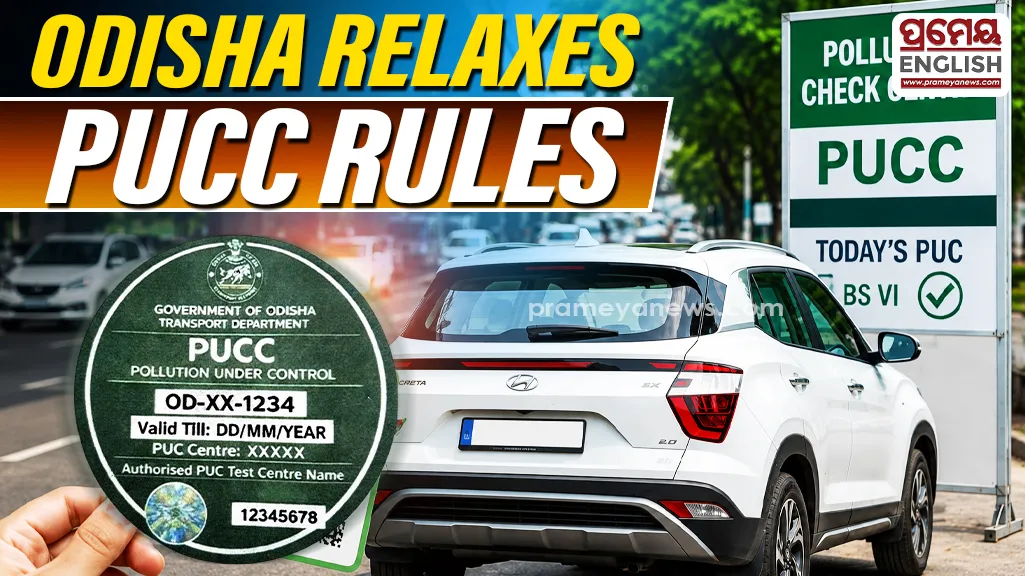
Bhubaneswar, Sept 2: After months of demands from vehicle owners, the Odisha Transport Department is likely to reduce the penalty for not having a valid Pollution Under Control Certificate (PUCC). Transport Minister Bibhuti Bhushan Jena is expected to announce the decision in Bhubaneswar today.
Odisha had imposed a maximum fine of ₹10,000 for vehicles without a valid PUCC, making it one of the states with the highest penalties in the country after Delhi. The steep fine had triggered widespread resentment among vehicle owners.
The issue has remained a matter of concern for nearly a year. Earlier, the government had announced that vehicles without a valid pollution certificate would not be allowed to refuel at petrol pumps. The decision sparked strong public opposition and was subsequently withdrawn.
However, the ₹10,000 penalty continued to draw criticism, with vehicle owners alleging that the amount was excessively high. Under the Motor Vehicles Act, penalties for violations related to pollution certificates can range from ₹1,000 to ₹10,000, leaving state governments the discretion to determine the applicable fine.
In several other states, the penalty for the first violation is ₹1,000, while a repeat offence attracts a fine of ₹2,000. Odisha, however, had prescribed a penalty of up to ₹10,000 for the offence.
The controversy intensified after automatic challans for vehicles without PUCCs were introduced at various toll plazas. Following the backlash, the Transport Department had indicated that the penalty would be reduced.
Nearly 10 months after that assurance, the state government is now expected to announce the revised penalty structure.
According to sources, Odisha is likely to reduce the fine from ₹10,000 to ₹1,000. Under the proposed arrangement, a vehicle owner caught without a valid pollution certificate for the first time would be fined ₹1,000. The same penalty is also likely to apply for a second offence, although the final notification is awaited.
The government’s move is expected to provide relief to vehicle owners while retaining the requirement for valid pollution certificates as part of the state’s efforts to control vehicular emissions.