
.webp)


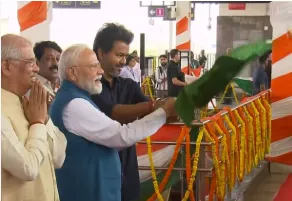
Chennai, October 11: Prime Minister Narendra Modi on Sunday inaugurated the Poonamallee–Vadapalani stretch of Phase II of the Chennai Metro Rail Project, constructed at a cost of around Rs 4,900 crore, marking a significant step towards strengthening urban transport infrastructure in Tamil Nadu.
Following the inauguration, Modi travelled by metro from Porur Bypass Station to Poonamallee Bypass Station and back. Tamil Nadu Chief Minister C Joseph Vijay was also present on the occasion.
The Prime Minister is scheduled to lay the foundation stone for and inaugurate several infrastructure and development projects across Tamil Nadu, covering roadways, railways, ports, energy, scientific research and education.
The projects are aimed at improving connectivity, reducing travel time, easing congestion, strengthening logistics infrastructure and supporting economic growth across the state.
Modi will inaugurate and lay the foundation stone for National Highway projects worth around Rs 3,700 crore.
Among the key projects is the 36-km, four-laned Vadugapatti–Therkuvenganallur section of NH-744. The highway stretch is expected to improve connectivity to important pilgrimage, industrial and commercial centres, facilitating the smoother movement of passengers and goods.
He will also inaugurate the 30-km, four-laned Madurai Ring Road section of NH-744A. The project is expected to ease traffic congestion in Madurai and improve the movement of vehicles around the city.
In addition, the Prime Minister will lay the foundation stone for the four-lane Thiruvarur Bypass on the Nagapattinam–Thanjavur section of NH-83. The bypass will provide an alternative route around Thiruvarur, strengthening regional connectivity and facilitating smoother traffic movement.
The Prime Minister will dedicate and inaugurate railway infrastructure projects worth more than Rs 750 crore.
He will dedicate the Karaikal–Peralam railway line, which is expected to further strengthen rail connectivity in the region. Three rail flyovers in Coimbatore and surrounding areas will also be dedicated to the nation. These projects are designed to reduce congestion at busy railway level crossings, minimise waiting time and improve road safety.
Modi will also inaugurate five redeveloped Amrit Stations at Palani, Vellore Cantonment, Ambasamudram, Paramakkudi and Namakkal under the Amrit Bharat Station Scheme.
The station redevelopment initiative seeks to upgrade passenger amenities and modernise railway infrastructure.
Several port-related projects will be inaugurated or launched to strengthen Tamil Nadu's maritime infrastructure, expand cargo-handling capacity and improve logistics efficiency.
At Chennai Port, the Prime Minister will inaugurate four infrastructure projects, including a paved storage yard, four export-import (EXIM) godowns, an upgraded cruise terminal and a Seafarers Club.
The projects are expected to improve cargo storage and handling, increase warehousing capacity and modernise facilities for cruise passengers. The upgraded cruise terminal will enable the simultaneous embarkation and disembarkation of more passengers, while the Seafarers Club will provide modern welfare, recreational and support facilities for maritime personnel.
At VO Chidambaranar Port, Modi will inaugurate and lay the foundation stones for eight major development projects. These initiatives will expand cargo and container-handling capacity, support the transition towards cleaner maritime energy and improve cargo evacuation and logistics within the port ecosystem.
The Prime Minister will also inaugurate the Coal Berth-3 project at Kamarajar Port and lay the foundation stone for capital dredging works for Container Terminal Phase-I, Stage-II.
Modi will lay the foundation stone for a Group II/III Lube Oil Base Stocks (LOBS) project at the existing Manali Refinery of Chennai Petroleum Corporation Limited (CPCL) in Chennai.
The project, estimated to cost around Rs 1,620 crore, will have a production capacity of 270 thousand metric tonnes per annum (TMTPA).
It aims to manufacture Group II/III lube oil base stocks for producing premium-quality lubricants in India, supporting the domestic lubricant industry and strengthening the country's manufacturing capabilities.
The Prime Minister will dedicate the Sudha Gopalakrishnan Brain Centre (SGBC) at IIT Madras to the nation.
He will also launch a pioneering global scientific mission to map more than 100 human brains into three-dimensional atlases at cellular resolution. The initiative will cover the human lifespan, from the foetal stage to old age, and is expected to contribute to advanced brain research.
Modi will also release C-STROKE, a human ischaemic stroke atlas featuring more than 1,000 annotated microscopic sections from a stroke-affected brain.
The atlas is expected to help researchers worldwide study stroke-related changes in brain tissue and identify potential new therapeutic targets.
The Prime Minister will participate in the golden jubilee celebrations of Jaigopal Garodia Hindu Vidyalaya Matriculation Higher Secondary School in Chennai.
The occasion marks five decades of the institution's contribution to education and its role in nurturing generations of students through academic excellence, discipline, cultural values and holistic development.
Guided by its motto, “Sa Vidya Ya Vimuktaye” (Knowledge that liberates), the school seeks to develop students who contribute meaningfully to society.
The inauguration of the Chennai Metro stretch, along with the planned rollout of projects across multiple sectors, underscores the focus on strengthening Tamil Nadu's transport networks, industrial infrastructure, scientific research capabilities and educational institutions.
.webp)