


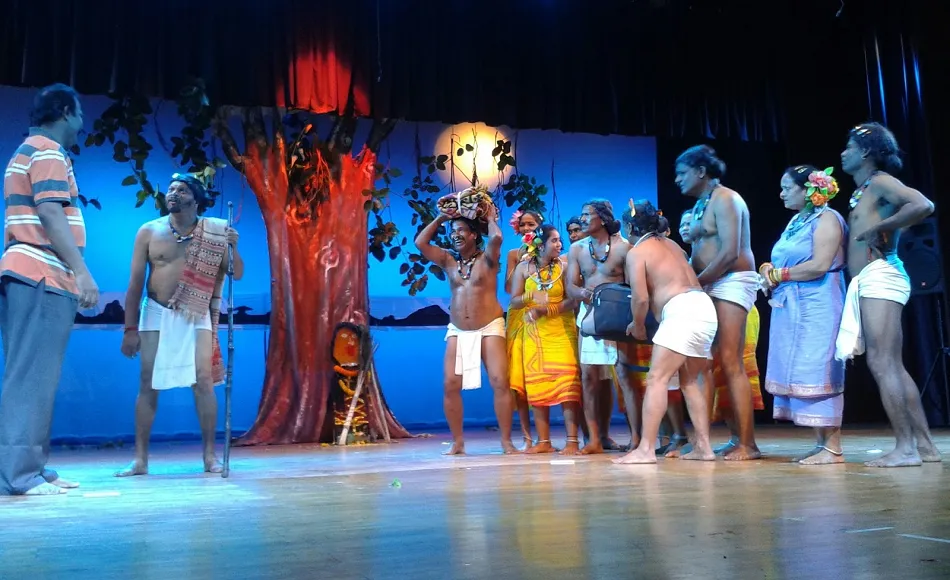
Bhubaneswar, Jul 18: Odisha’s theatre movement has witnessed remarkable growth over the past decade, with a sharp rise in the number of drama groups, artists, and theatre festivals. However, theatre practitioners say the development has not been matched by adequate infrastructure or financial support, leaving the state's vibrant stage culture struggling for survival.
According to theatre organizations, Odisha now has more than 200 theatre groups, with over 50,000 amateur and semi-professional artists actively involved in stage productions. The state also hosts over 15 state-level and 17 national-level theatre festivals every year.
Since 2012, the monthly theatre programme 'Natyadhara' has provided performance opportunities to theatre groups. Troupes located within a 200-kilometre radius of Bhubaneswar perform during the first three days of every month at Bhanja Kalamandap, while groups from farther districts stage performances at Rabindra Mandap on the second Sunday of each month.
Despite this growth, theatre artists argue that Odisha continues to face a severe shortage of performance venues. "Theatre has grown, but stages have not," they say, pointing out that the increasing number of productions is far greater than the available infrastructure.
Various theatre organizations have repeatedly appealed to the government for improved facilities, but claim that their demands have remained largely confined to assurances. Many artists expressed concern that while the government is focusing on the film industry, live theatre—the cradle of acting talent—is being overlooked.
President of the Odisha Natya Sangha, Mihir Kumar Meher, said Odisha urgently needs modern theatre-friendly auditoriums. He noted that apart from Rabindra Mandap in Bhubaneswar, which has been renovated for stage performances, the state lacks suitable theatre venues. While district headquarters now have Sanskriti Bhavans, he said these are primarily used for meetings and official functions rather than theatrical productions.
Meher said the association has proposed the construction of a dedicated Natya Bhavan in Bhubaneswar and requested that the city's Sanskriti Bhavan be upgraded into a proper theatre venue. He also called for increased funding under the Natyadhara programme, more zonal workshops, seminars, theatre festivals, higher government grants for cultural events, restoration of historic theatres in cities like Cuttack and Puri, and preservation of the legacy of legendary theatre personalities.
Echoing similar concerns, Dhirendra Nath Mallik, President of the Kalinga Natya Sangha, urged the government to establish at least one fully equipped theatre complex in each of Odisha's 147 Assembly constituencies. He suggested that these complexes include modern stages, galleries, parking facilities, cafeterias, shopping areas, and cinema halls.
Mallik also recommended creating dedicated rehearsal spaces at district and block levels, expanding the Natyadhara programme across Odisha instead of limiting it to Bhubaneswar, reviving the Natya Unnayan Samiti to support theatre activities, introducing research fellowships and repertory companies, and extending academy awards to child artists and playwrights.
Theatre activists believe that without stronger government intervention, improved infrastructure, and sustained financial assistance, Odisha's rapidly expanding theatre movement may struggle to achieve its full potential despite its growing popularity.