

.webp)


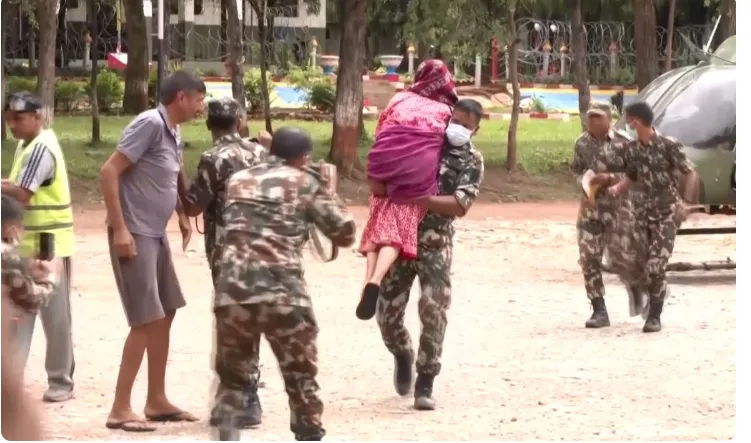
Nuwakot (Nepal), August 29: Survivors of the devastating floods that swept through Nepal’s mountainous region bordering Tibet are being airlifted to safety as rescue and relief operations continue in the affected areas.
 Nepal Army helicopters transported stranded survivors to the Maithili Army Camp in Nuwakot district, where army personnel provided them with shelter in tents and other assistance.
“I have lost everything; my house and belongings are all gone,” a woman from Nepal’s Rasuwa district told Reuters after being rescued.
In Betrawati, one of the worst-hit areas, residents described the destruction caused by the August 26 floods. A once-thriving neighbourhood, home to a market, temple and school, has been almost completely wiped out.
“There was a temple right in front, and this entire area was a market. In that open space in the middle, there used to be a school,” a local resident told Reuters. He said teachers had managed to evacuate students to safety on the day of the floods, but there is now “absolutely no trace” of the school.
“Everything was swept away. Many people died here; there is still no information regarding exactly how many lives were lost,” he said.
The floods have also severely damaged roads and other infrastructure. In Betrawati, a major road has been washed away and merged with the river, while several remote areas remain inaccessible even to rescue teams.
In neighbouring Rasuwa district, people stranded in remote and badly affected areas are being evacuated by helicopter.
 According to the Nepal Army, as of 8 am on Saturday, rescue teams had evacuated 2,265 people, including 163 foreign nationals, by helicopter. Another 200 people were rescued through ground operations, while 1,706 injured people received treatment at the Emergency Treatment Centre.
The Nepal Army has deployed around 6,700 personnel for rescue and relief operations across the disaster-hit areas.
Meanwhile, the death toll from the Bhotekoshi flood disaster has risen to 626, while 2,426 people remain missing, according to the National Disaster Risk Reduction and Management Authority (NDRRMA).
Rescue teams continue to face significant challenges as damaged roads, difficult terrain and widespread destruction hamper efforts to reach survivors in isolated parts of the region.
.webp)