
.webp)
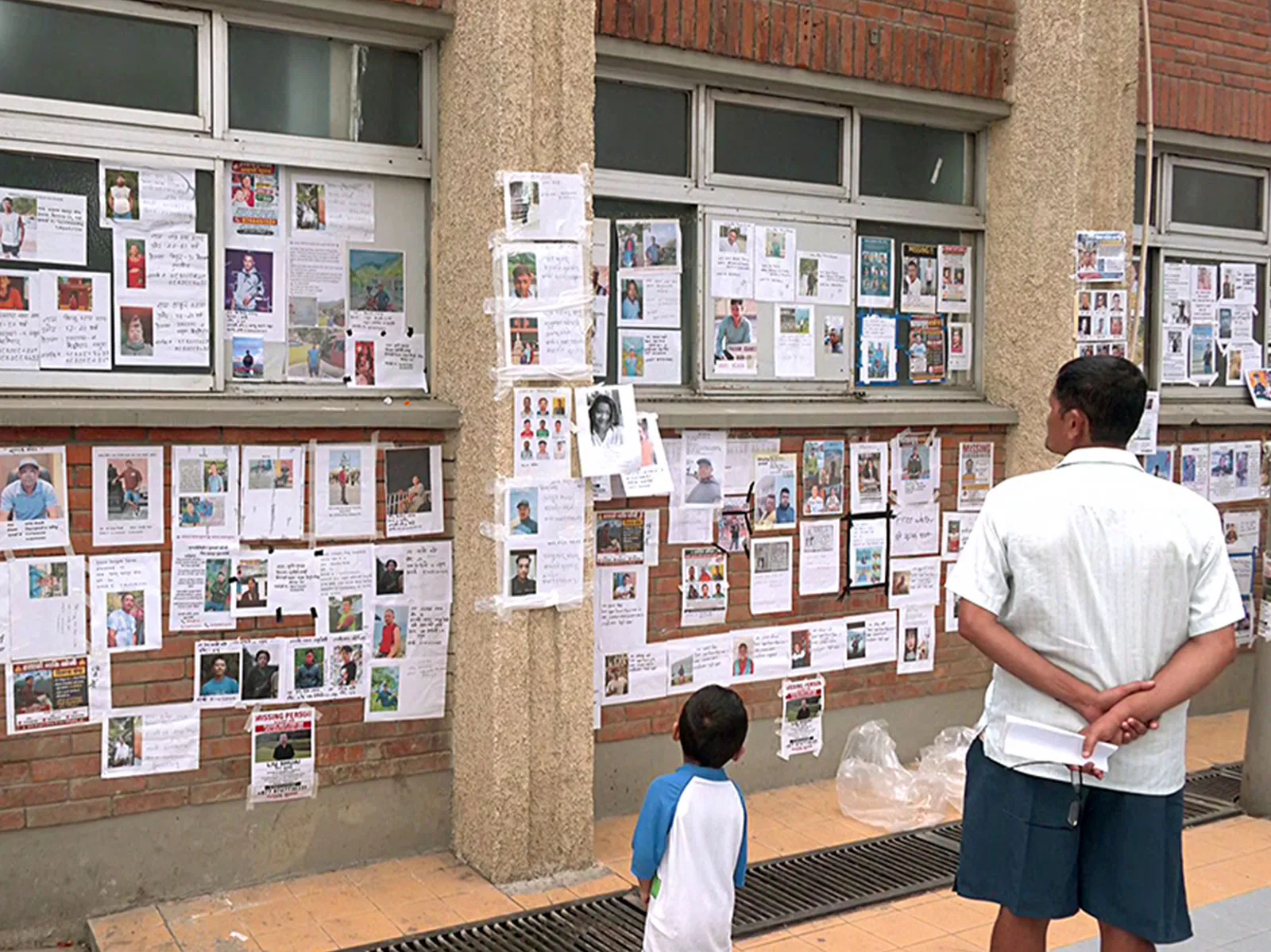
Kathmandu, Aug 30: Laxmi BK, along with her mother and other relatives, stuck the photos of her father and uncle on the walls of the Teaching Hospital with the hope that someone would recognise them and tell them their last whereabouts.
Laxmi's father and uncle Purna and Suklal had gone to the Timure bordering Tibet for work and have been missing since Wednesday's Himalayan Tsunami. The family have scoured through the mortuaries, hospitals and all possible locations and authorities by various means but haven't got an update about their loved ones - the breadwinners of their family.
With the search and rescue operation entering the fifth day, hopes have slowly started to fade as they have been praying for a sort of miracle to find their loved ones.
"I also am hoping that I would be able to find my father and uncle, only their bodies if they're not alive. I just want to see them; I only have that wish now. If we cannot get them alive, then we want to see their body - at least, I request the government for it," Laxmi told ANI.
The family has gone through all the photos hanging on the side of the mortuary in Kathmandu and checked the list of the rescued and injured persons as well but was not able to find the names of their loved ones.
For Ritesh Karki, a tourism entrepreneur, it is a huge responsibility to find the whereabouts of his more than 35 friends who had gone to the Tibetan border side for a trek when the disaster struck.
Holding the photos of the missing group on his phone, he has been searching around the mortuary and checking all the hospitals to get some news about the missing ones.
"I went to many of the places, from the airport to the morgue at the Teaching Hospital and all probable places in search of them. It was a trekking group of about 35 people whose name hasn't appeared on any of the lists, there is no update about the search and rescue operation; we are still waiting for the news," Ritesh told ANI.
Hundreds of relatives and families of people missing in the Tibet-Nepal flood, which wiped out the entire settlement along the rivers after a sudden burst of the glacial lake and is being characterised as a Himalayan tsunami, have been visiting the mortuary and hospital on a daily basis. The family members and relatives go through the list of the admitted ones as well as register the names of the missing ones, as the death toll has continued to rise.
The Rescue Request Portal under the Office of the Prime Minister and Council of Ministers, which has been brought into operation following the disaster, has recorded entries of more than 12,000 people missing since August 26.
But these figures, as per the website, "are compiled from public complaints and reports. The same person may be reported more than once, in different contexts, so the true number of distinct individuals may be lower than shown."
Till 7 PM (NST) on August 30, 2026, the number of missing ones registered in the portal stands at 12327, whereas the official figure by the National Disaster Risk Reduction and Management Authority (NDRRMA) shows 2502 people are missing.
Provided the extent of damage and number of missing in the disaster, the loss of lives might surpass the number of deaths of the 2015 earthquake. As per Nepal's National Planning Commission, a total of 8773 casualties were recorded in the 7.8 magnitude earthquake.
With a steady rise in the number of deaths and a depleting possibility of finding the missing ones alive with the sluggish search and rescue operation, the system is again being tested.
The mortuary of Tribhuvan University Teaching Hospital, which is flooded with families and relatives, is struggling to cope with the flow of bodies.
"In our hospital we have received 59 (dead bodies); out of those we could recognise 8 and handed them over to the families for the final rites. The rest of the bodies are there in the forensic department. Due to limited space in the hospital mortuary, we have asked the administration to arrange some ways so we can manage more bodies which we are yet to receive," Professor Doctor. Gopal Sedhain, the spokesperson for the hospital, told ANI.
With mortuaries running out of space, the government has engaged in managing unidentified bodies by amending the Unidentified and Unclaimed Body Management Guidelines-2021.
A cabinet meeting amended the guidelines for the purposes of Section 22(a) of the Nepal Police Act, 1955. The government has primarily amended Section 14 of the guidelines, adding autopsies for persons who died due to disaster. This includes a provision that if a body or any organ or part of a body of a person deceased due to a disaster is found, and it is confirmed through an inquest report and preliminary physical examination that the death was caused by a disaster, only tests necessary for person identification may be conducted during the autopsy.
In Sub-section (1), a provision has been added requiring the collection and retention of necessary samples for testing, including DNA, to identify persons prior to managing unidentified or unclaimed bodies, body organs, or parts.
Similarly, in Sub-section (2), a provision has been added allowing unidentified or unclaimed bodies, body organs, or parts to be placed safely underground with identifying markers attached during management.
In Sub-section (3), a provision has been added stating that if a rightful heir of the stored body, organ, or part is identified and wishes to take custody, the body, organ, or part must be handed over to them.
Under the previous guidelines, there were provisions for the storage and protection of unidentified and unclaimed bodies. According to those, unidentified and unclaimed bodies were to be secured for a specified period in storage rooms at nearby federal, provincial, and local hospitals, storage rooms in community hospitals, government and community-run mortuaries, places designated by local levels, or other suitable locations.
Following this, the government made several amendments to the guidelines. Clause (c1) was added after Clause (c) of Section 2 of the main guidelines. It states that 'body management' shall mean temporary management carried out without complete last rites. In Clause (c) of the 2021 guidelines, 'unclaimed body' was defined as a body whose relatives or rightful heirs could not be traced or which remained unclaimed.
The government amended Section 10 of the guidelines to add a clarification. It specifies that 'body' shall also denote any organ or part of the body found.
Likewise, the government amended Section 11. In Clause (b) of Sub-section 4 of Section 11, the words 'managed bodies or' were added after the words 'unable to be handed over'.
Amending Clause (c) of the same section, the government replaced the words 'cremation/burial' with the words 'body management or cremation/burial'.
Section 13(1)(e) was amended, replacing 'unclaimed bodies' with 'body management of unclaimed bodies or', and Section 13(1)(f) was amended to replace 'cremation/burial' with the words 'body management or cremation/burial'.
Section 14 was amended to add Clause (d1) after Clause (d), establishing a provision that bodies of persons deceased due to disaster shall be managed at places designated by the District Disaster Management Committee. Clause (d) previously mentioned places designated by local levels on the recommendation of the committee for temporary body preservation. (ANI)
.webp)