


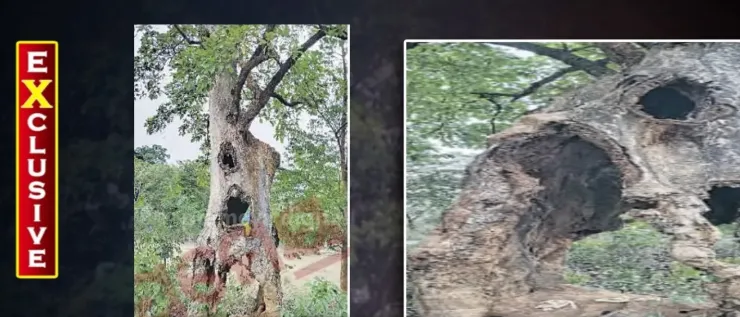
Baripada, June 15:In the heart of Odisha’s Mayurbhanj district stands a remarkable natural wonder that continues to intrigue visitors, scientists, and local residents alike. Along State Highway-19, near Bankishol village on the road from Murgabadi to Deuli, a gigantic Bharada tree has become a symbol of nature’s resilience and mystery.
Located about seven kilometres from Murgabadi, the tree appears almost impossible to survive. Its trunk is completely hollow from the base to the top, stretching more than 25 feet in length. The central core of the tree has long disappeared, leaving behind little more than its outer bark. Yet, despite lacking the solid structure that normally supports a tree, it has remained standing for more than five decades, astonishing everyone who sees it.
Over the years, the tree has withstood some of Odisha’s most devastating natural disasters, including the 1999 Super Cyclone, Cyclone Phailin, Hudhud, Titli, and numerous storms and thunderstorms. While many stronger-looking trees have fallen, this hollow giant continues to stand tall, almost as if challenging the forces of nature.
In Odisha’s Mayurbhanj district, a 50+ year-old Bharada tree defies nature’s rules. Fully hollow from base to top yet still standing tall, it remains a living mystery of resilience along SH-19 near Bankishol village. Nature truly has its own wonders.#Odisha #NatureMystery pic.twitter.com/KpifaEFZJI
— Prameya English (@PrameyaEnglish) June 15, 2026
Local resident Soren Murmu, now around 60 years old, says he has seen the tree in the same hollow condition since his childhood. According to local folklore, a giant cobra resides inside the tree and occasionally emits warning sounds before storms. While some villagers regard it as a sacred tree blessed with divine powers, others call it the “Tapaswi Tree,” believing it possesses extraordinary spiritual significance.
The tree’s unusual appearance has made it a popular attraction. Travellers often stop to admire its structure, take photographs and selfies, and create social media content. The site has also become a preferred location for photography and video shoots due to its unique and dramatic appearance.
However, experts offer a scientific explanation for the phenomenon. Botanists describe the condition as “Hollow Trunk Syndrome,” a process in which the inner heartwood decays while the outer bark and living tissues remain intact. Former Principal Chief Conservator of Forests and founder of the Save Elephant Foundation, Dr. Debabrata Swain, explained that the tree may have suffered lightning damage long ago, causing the inner wood to deteriorate over time.
According to Dr. Swain, a tree’s survival depends primarily on the cambium layer located beneath the bark. This thin living layer contains the xylem and phloem tissues responsible for transporting water and nutrients throughout the tree. As long as these vital tissues remain functional and the roots continue to absorb water from deep underground, a tree can survive even when its inner core has completely vanished.
Experts also point out that the hollow structure may actually help the tree withstand strong winds. Since air can pass through the cavity, wind pressure is reduced, allowing the tree to remain stable despite its fragile appearance.
While the hollow giant remains a fascinating example of nature’s adaptability, concerns persist about public safety because of its roadside location. Nevertheless, for local residents and curious visitors alike, the tree remains an enduring symbol of survival, resilience, and the enduring mysteries of the natural world.