
.webp)
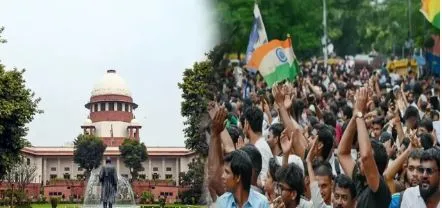
New Delhi, August 3:The Supreme Court on Monday clarified that the Delhi government and other state governments are free to close or withdraw FIRs registered against students who participated in recent protests over examination paper leaks, including demonstrations led by the Cockroach Janata Party (CJP) at Delhi's Jantar Mantar and other parts of the country.
A Bench comprising Chief Justice of India Surya Kant and Justices Joymalya Bagchi and V. Mohana explained that its July 28 order allowing prosecution of protesters with "criminal antecedents" was intended to apply only to those accused of grave and heinous offences.
The clarification came after counsel for several petitioners argued that authorities were interpreting the term "criminal antecedents" too broadly, resulting in cases remaining pending against students with minor offences such as traffic violations or participation in earlier protests.
Solicitor General Tushar Mehta informed the court that while the government remained committed to facilitating the withdrawal of cases against students, there was confusion over the legal process. He clarified that criminal law does not permit the withdrawal of an FIR itself. Instead, authorities may file a closure report, seek withdrawal of prosecution, or move the competent court to quash the proceedings.
Senior Advocate Abhishek Manu Singhvi urged the Bench to clearly define "criminal antecedents," contending that students should not face continued legal action over insignificant offences. In response, the Solicitor General noted that some accused individuals were facing serious charges, including murder and rape.
Senior Advocate N. Hariharan also raised concerns over the alleged use of facial recognition technology and biometric surveillance to identify protesters, arguing that participants had never consented to the collection or use of their biometric data.
Senior Advocate Gopal Shankarnarayan sought action against police personnel allegedly involved in excessive force, citing videos that purportedly captured incidents of violence. The Chief Justice observed that police officers responsible for brutality should not be shielded from accountability, while also stressing that individuals involved in serious crimes should not misuse student protests as protection from legal action.
Senior Advocate Vrinda Grover referred to a pending petition challenging the use of pellet guns against civilian protesters, stating that her research had found no legal or administrative framework authorising their deployment. The Chief Justice said the court would formulate guidelines governing the circumstances under which pellet guns may be used.
The Bench also indicated it was considering constituting either a Special Investigation Team (SIT) comprising police officers or a committee headed by a retired judge to investigate allegations of police excesses during the protests.
The matter has been posted for further hearing on August 18.
The Supreme Court is hearing a batch of petitions alleging excessive police action against students who participated in protests at Jantar Mantar and elsewhere over examination paper leaks. Families of injured police personnel have also approached the court seeking action against protesters accused of assaulting police officers.
The July 20 Parliament march, organised by the Cockroach Janata Party following weeks of protests and a hunger strike at Jantar Mantar, witnessed thousands of students attempting to march towards Parliament while demanding accountability over the examination paper leak issue.
.webp)