

.webp)
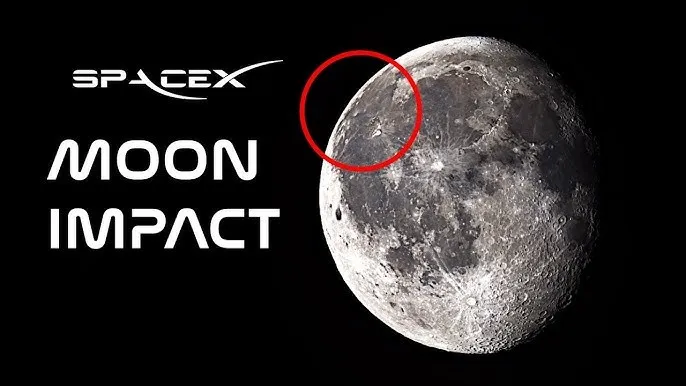
Abandoned SpaceX rocket hardware collides directly with lunar surface
Space hardware belonging to Elon Musk’s aerospace firm SpaceX slammed into the Moon around 12:05 PM IST, landing near the Einstein Crater on the lunar far side. Tracking data showed the 4,500-kilogram upper stage of a Falcon 9 rocket ending its 19-month drift through deep space. Official confirmation of the exact surface impact will take several hours as orbiting spacecraft align over the target coordinates.
Engineers originally launched the 12-meter-long rocket segment on January 15, 2025. It carried lunar landers into space, including Firefly Aerospace's Blue Ghost-1 and ispace's Hakuto-R Mission 2. Once the secondary engine ran out of fuel, solar activity and gravitational forces from Earth, the Moon, and the Sun gradually altered its flight path over several months. Faint pressure from sunlight also nudged the passivated stage into an inevitable collision course.
Striking without any atmosphere to create friction or drag, the rocket stage hit the ground at roughly 8,700 kilometers per hour. The violent impact released energy equivalent to approximately three tonnes of TNT. Planetary scientists expect the strike to excavate a fresh crater measuring between 20 and 30 meters across while displacing more than one million kilograms of lunar dust and regolith.
Scientific Importance for Deep Space Research
Human space exploration has occasionally left spent rocket boosters in high orbits since the Apollo era, making orbital debris management an essential subject for space safety. Natural meteorites strike the Moon randomly, but this controlled object provided a rare experiment. Researchers knew the precise weight, velocity, and geometry of the rocket stage before it struck, giving them an unprecedented opportunity to study artificial impacts in real time and advance lunar seismology techniques.
Global space organizations are now gathering visual evidence of the site. NASA's Lunar Reconnaissance Orbiter and South Korea's Danuri probe plan to compare historical imagery with upcoming surface scans. India's Chandrayaan-2 orbiter is also actively scanning the lunar surface from its orbit to detect the new structural mark left by the impact.
.webp)