


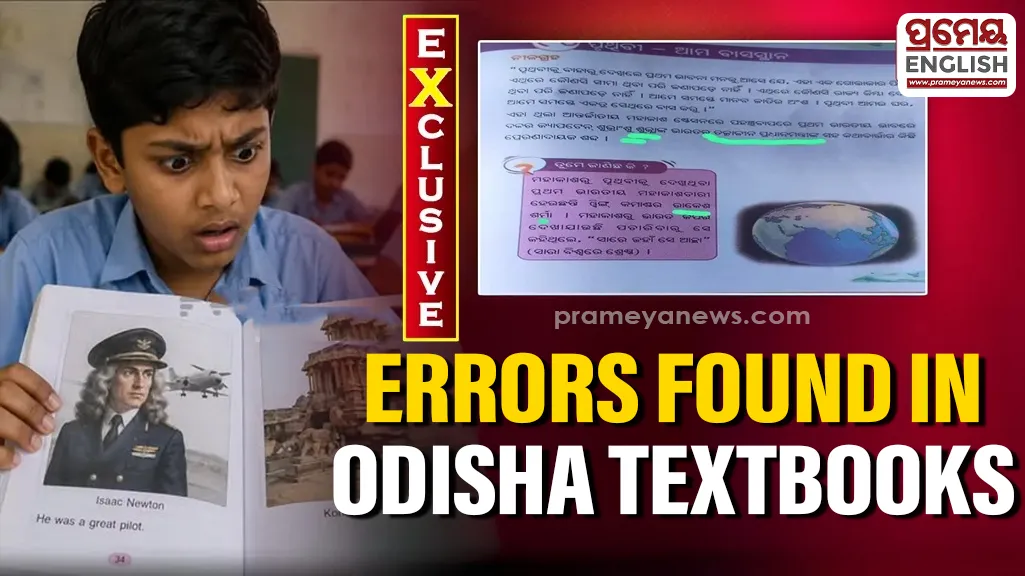
Bhubaneswar, June 24: A major controversy has erupted over the discovery of numerous errors in textbooks prescribed for Classes I to VIII in Odisha. Despite reportedly being aware of the mistakes for nearly two months, the School and Mass Education Department remained silent until the issue was highlighted by a media report. Following the disclosure, departmental authorities admitted that errors had indeed crept into the textbooks.
The Education Minister described the mistakes as “minor errors” and stated that teachers would correct them while teaching students. However, he clarified that the printing and distribution of the textbooks would not be halted. Instead, the department is now planning to provide correction stickers for books containing incorrect illustrations. These stickers will be sent to schools, and students will be asked to paste them over the erroneous images.
The issue has raised serious concerns about the future of young learners, with critics alleging that the department’s negligence could adversely affect students’ academic development.
For the 2026–27 academic session, the state government had approved the printing of 55 textbooks for Class- I to VIII. A state-level committee meeting was held on May 21 last year to finalize the process. The government planned to print nearly 29.8 million copies of textbooks. The Directorate of Teacher Education and the State Council of Educational Research and Training (SCERT) were entrusted with preparing the content, while the Directorate of Textbook Production and Marketing was responsible for printing and distribution.
However, citing inadequate printing capacity, the Directorate outsourced much of the work to private printing presses at a cost of approximately ₹21 crore. Printing assignments were issued from October last year, while the tendering process continued into November. Textbooks were supposed to reach schools before the beginning of the academic year, but printing delays meant that only about 14 million copies had been produced by the time schools reopened. Many schools initially received only around 10 percent of the required books.
Officials now claim that over 90 percent of the textbooks have been printed and around 80 percent have already been dispatched to block-level education offices. Shockingly, books continued to be supplied to districts such as Phulbani, Rayagada, and Koraput even after authorities became aware of the errors. While printing of some textbooks has reportedly been paused, cover pages continue to be printed and binding work is ongoing.
According to a senior official, only 1–1.2 million copies remain to be printed. He also revealed that the state-run printing unit handled only textbooks for Classes I to IV, while the remaining books were outsourced to private agencies. In some cases, printing materials for Urdu textbooks were sourced from outside the state.
Questions have also been raised about the functioning of the 24-member committee formed to oversee textbook preparation. Several senior officials and educationists listed as members reportedly claim they were neither consulted nor invited to meetings. Critics allege that the committee existed only on paper, while a handful of officials took key decisions without broader consultation.
The controversy gained momentum after reports surfaced that as many as 1,678 errors had been identified across textbooks from Classes I to VIII. The revelations prompted the state government to act. Chief Minister Mohan Charan Majhi reportedly convened an urgent meeting, expressed displeasure over the lapses, and ordered an investigation.
A three-member inquiry committee headed by the Development Commissioner was constituted on June 18 and directed to submit its report within seven days. With the deadline approaching, attention is now focused on the findings of the probe. Meanwhile, teachers’ associations have demanded that the investigation report be made public and that accountability be fixed for the large-scale errors in the textbooks.