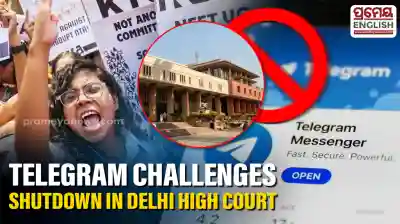


New Delhi, June 18: The Central Government on Thursday justified its decision to temporarily block messaging platform Telegram until June 22, informing the Delhi High Court that the application's design and operational framework had facilitated organised cheating networks linked to the NEET re-examination. The government maintained that the restriction was a preventive measure aimed at protecting the credibility of a crucial national examination.
Representing the Centre, Solicitor General Tushar Mehta and Attorney General R. Venkataramani argued that Telegram's challenge to the blocking order lacked merit and that the action was necessary to safeguard the interests of lakhs of students appearing for the examination. Additional Solicitor General Chetan Sharma and Advocate Ashish Dixit, appearing for the Central Government Standing Counsel, were also present during the proceedings.
After hearing detailed submissions from both sides, Justice Tejas Karia reserved his order on Telegram's plea challenging the blocking directive issued under Section 69A of the Information Technology Act.
Defending the government's decision, Solicitor General Mehta told the Court that the blocking order was issued following due process and was subsequently reviewed by a committee headed by the Cabinet Secretary. He said authorities possessed substantial evidence indicating misuse of the platform in connection with examination-related malpractice and urged the Court to consider the larger public interest involved.
Supporting the Centre's stand, Attorney General Venkataramani argued that the order clearly outlined the reasons for intervention and that Telegram's reliance on the principle of proportionality was misplaced. He contended that the platform's architecture posed unique challenges and enabled misuse on a scale requiring immediate preventive action.
Addressing Telegram's argument that other social media and messaging services had not faced similar restrictions, the Attorney General said such comparisons were inappropriate. According to the Centre, other intermediaries have effective filtering and moderation mechanisms that help address unlawful content, whereas Telegram's structure created distinct concerns.
Senior Advocate Dhruv Mehta, appearing for Telegram, challenged the blocking order as unconstitutional and disproportionate. He argued that alleged misuse by a limited number of users could not justify suspending access to an entire platform used by millions across the country.
Telegram further submitted that it had cooperated with law enforcement agencies and taken action against channels and groups involved in illegal activities. The platform argued that the government's decision imposed a blanket restriction on legitimate users and failed to meet the constitutional requirement of proportionality. It also contended that less restrictive alternatives were available and that authorities had not demonstrated why a complete suspension was necessary.
The Centre, however, maintained that Telegram's features distinguished it from other intermediaries and made it particularly vulnerable to the circulation of leaked examination material and related fraudulent content. According to the government, the temporary restriction was imposed solely as a precautionary measure ahead of the NEET re-examination to ensure the integrity of the examination process.
The High Court had earlier sought the Centre's response to Telegram's petition and took up the matter on an urgent basis, considering that the temporary restriction is scheduled to remain in force until June 22.