

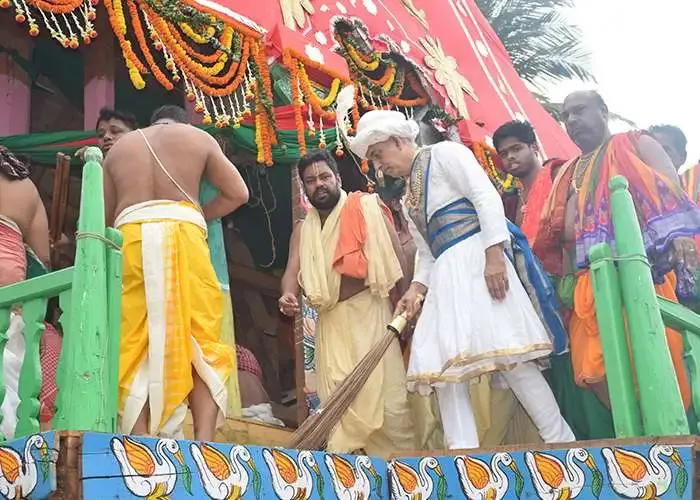
Puri, Jul 24: Gajapati Maharaja of Puri, Divyasingha Deb, on Friday performed the sacred ‘Chhera Pahanra’ ritual, ceremonially sweeping the platforms of the three chariots of Lord Jagannath, Lord Balabhadra and Devi Subhadra before the commencement of the Bahuda Yatra.
Dressed in traditional white attire and carried in a silver-plated palanquin, the titular king of Puri arrived at the Grand Road and ascended each chariot. Using a golden-handled broom, he swept the chariot platforms as priests chanted Vedic hymns and offered flowers and fragrant water. He also performed Aarti and Chamer Seva before the sibling deities.
The ritual began at Lord Balabhadra’s Taladhwaja chariot, followed by Lord Jagannath’s Nandighosha, and concluded at Devi Subhadra’s Darpadalana chariot. The Gajapati performs the ritual only after being formally informed by temple officials that the deities have been ceremonially seated on their respective chariots.
Regarded as the first servitor (Adya Sevak) of Lord Jagannath, the Gajapati Maharaja performs the Chhera Pahanra as part of the temple's ancient Rajaniti (royal rituals). The ceremony is also observed during Snana Purnima and the Bahuda Yatra, reflecting centuries-old traditions associated with the Jagannath cult.
According to temple records, the tradition dates back to the 12th century when Anantavarman Chodaganga Deva declared himself a humble servant of Lord Jagannath, establishing the custom that the ruler governs as the Lord's representative rather than as an absolute monarch.
Scholars of Jagannath culture say the ritual carries a profound social message of equality. By sweeping the chariots despite being a king, the Gajapati symbolises that all are equal before Lord Jagannath, irrespective of status, wealth or position. After the completion of the ritual, the wooden horses are attached to the three chariots, paving the way for lakhs of devotees to pull the chariots during the sacred return journey to the Shree Jagannath Temple.