.webp)

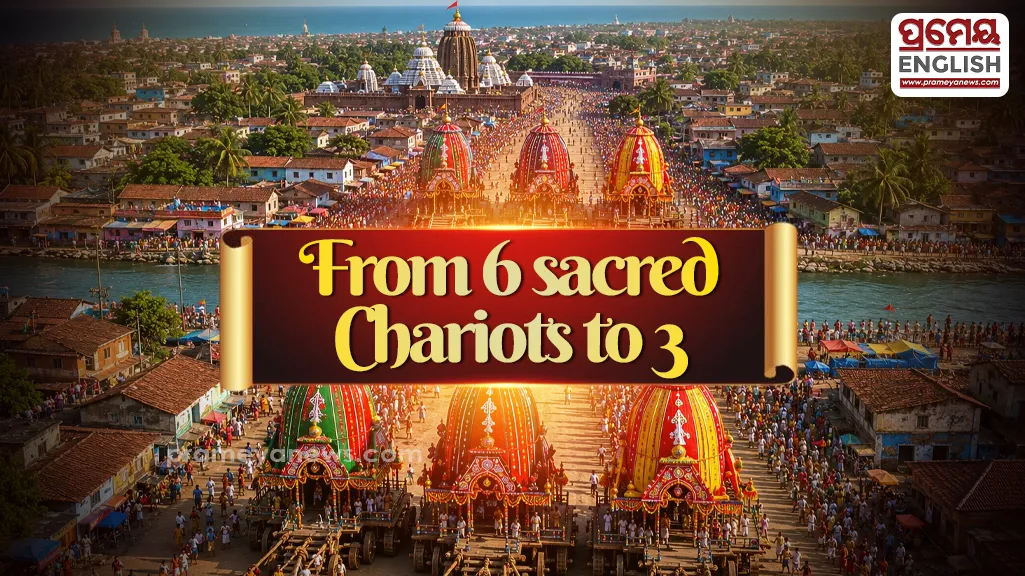
Puri, Jul 1: Lord Jagannath, revered as ‘Daru Brahma’, is worshipped as the creator, protector and supreme force guiding the universe. Along with his divine presence comes countless legends that have been passed down through generations. One such fascinating tale explains why the world-famous Rath Yatra in Puri is now celebrated with three chariots, when tradition once required six.
According to temple lore, long ago a river named Malini, a tributary of the Shankhua River, flowed between the Shree Jagannath Temple and the Gundicha Temple. During the reign of King Indradyumna, the Rath Yatra was conducted with great religious fervour, but unlike today, there was no Grand Road (Bada Danda) connecting the two temples.

Since the chariots could not cross the river, three chariots were stationed near the Lion's Gate (Singhadwara) of the Jagannath Temple, while another three were built on the opposite bank near the Gundicha Temple. During the Rath Yatra, the deities were taken in the first set of chariots up to the banks of the Malini River. They were then ferried across the river and placed on the second set of chariots, which carried them to the Gundicha Temple.
However, the Malini River often created difficulties for devotees and the royal family. During the monsoon, the river would swell, delaying the return journey of the deities from the Gundicha Temple. At times, Lord Jagannath and his siblings remained at the Gundicha Temple for weeks, disrupting the regular temple rituals.
The legend takes a dramatic turn during the reign of Gajapati Pratap Bhanu Dev. His mother, Queen Shraddhamani Devi, was an ardent devotee of Lord Jagannath and would never eat or drink before having the Lord's darshan each day.
Heavy rainfall floods in the Malini River prevented the deities from returning to the Jagannath Temple after Rath Yatra. Unable to have the Lord's darshan, the queen refused to consume food or water and gradually became critically weak.
Moved by the unwavering devotion of his devotee, Lord Jagannath is believed to have appeared before Queen Shraddhamani Devi in a dream. The Lord instructed her to ask devotees to bring handfuls of sand from the seashore and fill the Malini River. He assured her that this would solve the problem forever.
The next morning, thousands of devotees followed the divine instruction, carrying sand from the beach and filling the river. The place came to be known as Sharadha Bali, commemorating the queen's devotion. It is also believed that a bridge was later constructed over the filled-up riverbed at a spot now known as Balagandi.

With the Malini River no longer obstructing the route, a straight ceremonial road was established between the Jagannath Temple and the Gundicha Temple. This road eventually became the famous Bada Danda (Grand Road), allowing the deities to travel directly to the Gundicha Temple.
From that point onward, the tradition of using six chariots came to an end, and the Rath Yatra has since been celebrated with the three majestic chariots—Nandighosha of Lord Jagannath, Taladhwaja of Lord Balabhadra, and Darpadalana of Devi Subhadra.
Though rooted in temple tradition and folklore rather than historical documentation, the story remains one of the most cherished legends associated with the evolution of Puri's iconic Rath Yatra.
.webp)