


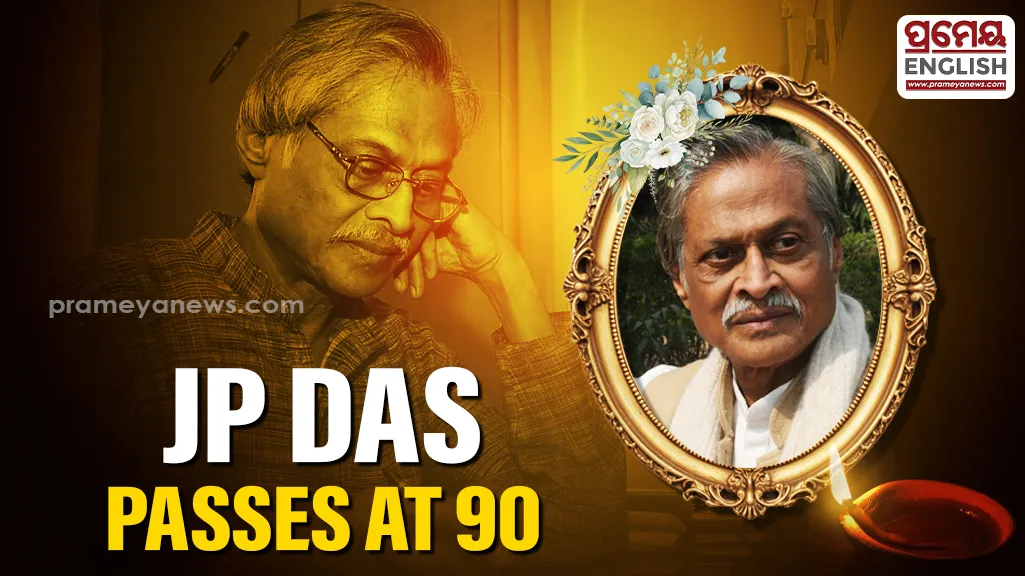
Bhubaneswar, Jun 4: Renowned Odia poet, playwright, art historian, and former Indian Administrative Service (IAS) officer Jagannath Prasad (JP) Das passed away at his residence in Bhubaneswar on Wednesday night. He was 90.
JP Das leaves behind a rich and multifaceted legacy spanning literature, administration, theatre, translation, and art history, making him one of the most distinguished cultural figures of post-independence Odisha.
Born on April 26, 1936, in Puri district, Das joined the IAS in 1958. During his administrative career, he earned wide recognition for his leadership in relief and rehabilitation efforts as Collector of Kalahandi during the devastating famine and drought of 1965–66.
At the peak of his bureaucratic career, he took voluntary retirement in 1984 to fully dedicate himself to literature and creative arts.
A leading voice in modern Odia literature since the 1960s, JP Das authored several celebrated poetry collections including Prathama Purusha, Ahnika, and Parikrama. His works are noted for their modernist expression, philosophical depth, and cultural introspection. In recognition of his literary contribution, he was awarded the prestigious Saraswati Samman in 2006.
Known for his strong principles, he had earlier declined the Sahitya Akademi Award in 1990.
Beyond poetry, he made significant contributions to Odia theatre with experimental and absurdist plays such as Suryasta Purbaru and Sundara Das. He also authored the acclaimed historical novel Desha Kala Patra.
JP Das was also a strong advocate for literary communities and founded the Poetry Society (India), serving as its president for 14 years.
A bilingual writer and skilled translator, he helped introduce Odia literature to global audiences by translating works into and from Swedish, Urdu, French, and English.
His expertise in visual arts further enriched his scholarship on Odishan heritage. His notable works on art history include Puri Paintings (1982) and Palm-Leaf Miniatures (1991), which remain important references in the field.
With his passing, Odisha has lost one of its most versatile intellectuals and a towering cultural figure who significantly shaped modern Odia literature and art.