

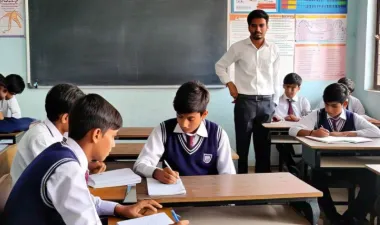
Delhi, March 20:In a significant step towards realising the vision of Viksit Bharat 2047 and strengthening the foundations of an Aatmanirbhar Bharat, as articulated by the Prime Minister Narendra Modi, the Department of School Education and Literacy (DoSEL), Ministry of Education, Government of India, is set to launch a nationwide drive to identify and enrol out-of-school and dropout children.
The National Education Policy (NEP) 2020 sets a target of achieving 100% Gross Enrolment Ratio (GER) from pre-school to secondary level by 2030. However, according to the annual report of the Periodic Labour Force Survey (PLFS) 2023-24, nearly 2 crore children aged 14-18 years are not attending school, while around 11% of children in Grades 3-8 remain out-of-school and over 50 lakh students fail board examinations each year.
To achieve the goal of 100% GER, it is essential to bring these children back into the education system at the earliest and to prevent further dropouts. Open schooling offers a practical alternative for children unable to attend regular schools due to economic, social, or geographical constraints.
The National Institute of Open Schooling (NIOS), an autonomous body under the Ministry and the largest open school board in the world, provides inclusive and flexible access to quality school education and skill development through open and distance learning, promoting universalisation, equity and social justice. As the world's largest open schooling board, NIOS offers flexible admissions, multiple opportunities to clear examinations, an On-Demand Examination System, vocational and skill-based courses aligned with employability, inclusive provisions for Divyang learners, and certification that is recognised on par with other national and state boards.
The National Education Policy 2020 emphasises tracking of students, as well as their learning levels, in order to ensure that they are enrolled in and attending school and have suitable opportunities to catch up and re-enter school in case they have fallen behind or dropped out. In view of this, the Ministry, with the support of the State and UTs, intends to initiate a drive to contact out-of-school or dropout children. Officials from NIOS will be engaging with States and Union Territories to strengthen institutional collaboration and advance the cause of dropout children, a reliable and credible open schooling framework across the country.
The data drawn from district-level surveys of respective state / UT governments will assist NIOS in identifying and contacting out-of-school or dropout children for upcoming enrolment drives. To ensure last-mile connectivity, NIOS will roll out the "NIOS Mitra" programme, a structured and technology-enabled outreach initiative designed to mobilise communities and facilitate enrolment. Trained facilitators will identify and counsel out-of-school children, support their enrolment, and provide academic guidance with special focus on marginalised, tribal, migrant, minority and economically disadvantaged groups. The programme will operate within a transparent and digitally monitored system to ensure accountability and measurable outcomes.
The Ministry is also focussing on strengthening access, quality and standardization in school education, including improving the effectiveness of open schooling systems. With more than 10,800 Study and Examination Centres across States and Union Territories, NIOS provides a scalable platform capable of mainstreaming large numbers of learners who require flexibility due to social, economic or personal circumstances. To expand these efforts and to strengthen credibility and transparency, the Ministry, through NIOS, will work closely with States and Union Territories to establish at least one NIOS Study and Examination Centre in every block.