
.webp)
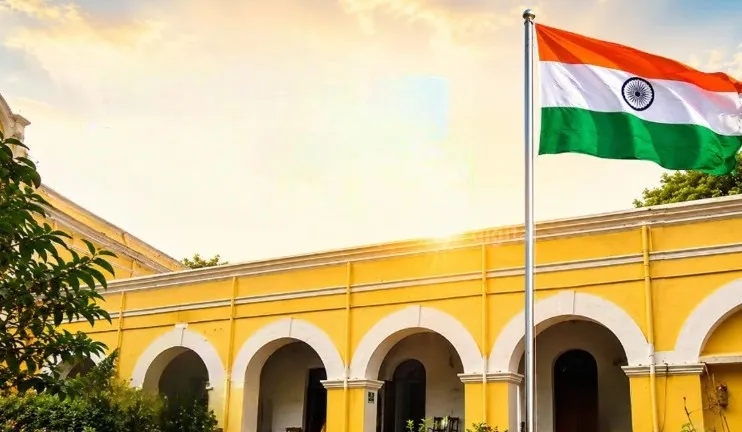
Cuttack, Aug 15: In the historic city of Cuttack stands a house whose walls, courtyard and very surroundings carry memories of Odisha’s freedom struggle. Chaudhuri Niwas at Bakharabad, beside the Kathajodi Ring Road, is regarded as one of the important landmarks associated with the state’s nationalist movement.
It was here, according to historical accounts, that the national flag was hoisted in Odisha in 1921, when former Odisha Chief Minister Nabakrushna Choudhury raised the flag atop the two-storeyed building.
More than a century later, Chaudhuri Niwas continues to evoke memories of a period when the call for freedom brought an entire family into the national movement.
A family that joined the freedom struggle
The Chaudhuri family occupies a unique place in Odisha’s history. Gopabandhu Choudhury, son of Gokulananda Choudhury and Padmavati, gave up his prestigious post as a Deputy Collector to join the freedom movement.
His wife, Rama Devi, became one of Odisha’s prominent women freedom fighters and was imprisoned several times for her participation in the national movement.
The family's next generation also became involved in the struggle. Gopabandhu Choudhury’s son Manmohan, daughter-in-law Sumitra, daughter Annapurna and son-in-law Sharat participated in the movement. His younger brother Nabakrushna Choudhury, wife Malati Devi and their eldest daughter Uttara Desai were also associated with the freedom struggle.
In this sense, Chaudhuri Niwas became far more than a family residence—it emerged as a centre of nationalist activity.
The flag was hoisted again in 1930
The house witnessed another important moment during the freedom movement.
After the Lahore Congress session of 1929, where the call for Purna Swaraj was formally adopted, January 26, 1930, was observed as Independence Day across the country.
On that historic morning, the national flag was again hoisted on the roof of Chaudhuri Niwas, turning the building into a symbol of Odisha’s participation in the nationwide campaign for complete independence.
Where the ‘Vanar Sena’ Worked
Chaudhuri Niwas was also associated with the activities of the Vanar Sena, in which children participated in the freedom movement.
Young volunteers reportedly picketed outside shops selling liquor, ganja and foreign-made clothes. Some were beaten by the police and later treated at Chaudhuri Niwas. Several also participated in Satyagraha and were arrested.
The house thus became a place where young patriots learned the meaning of protest, sacrifice and civil resistance.
From Cuttack to the Salt Satyagraha at Inchudi
The nationalist activities connected with Chaudhuri Niwas were not confined to Cuttack.
Under the leadership of Gopabandhu Choudhury and Acharya Harihar, groups of volunteers set out from the house and joined the historic Salt Satyagraha at Inchudi in Balasore.
The march symbolised the growing strength of the Civil Disobedience Movement in Odisha and the determination of ordinary people to challenge British rule.
A Residence Linked to Odisha’s Political History
Chaudhuri Niwas also became associated with some of Odisha’s most prominent political figures.
Nabakrushna Choudhury, who later became Odisha’s Revenue Minister and Chief Minister, had a close association with the house. The residence was also linked with Biswanath Das, another important political leader of Odisha.
Following Mahatma Gandhi’s death, the Utkal Gandhi Smarak Nidhi was formed under the leadership of Malati Devi. The Gandhi Bhavan at Bakharabad, associated with Chaudhuri Niwas, became part of the property of the Gandhi Smarak Nidhi.
The Gandhi Statue That Still Stands Here
One of the most poignant attractions at Chaudhuri Niwas is a statue of Mahatma Gandhi that continues to be preserved within the premises.
Historical accounts say that when Gandhi visited Puri during the freedom movement, an artist presented him with a statue. Gandhi later gave it to Annapurna, the daughter of Rama Devi.
The statue eventually came to Chaudhuri Niwas and continues to be preserved at the site, where it is still revered.
A House That Refuses to Let History Be Forgotten
Today, Chaudhuri Niwas may appear to be another old building in Cuttack. But behind its doors lies a remarkable story of courage, sacrifice and political awakening.
It witnessed the hoisting of the national flag, sheltered freedom fighters, became associated with the Vanar Sena, sent volunteers towards the Salt Satyagraha and remained connected with some of the most influential personalities of Odisha’s freedom movement.
Chaudhuri Niwas is not merely a historic house—it is a living reminder of the generations who gave up comfort, careers and even freedom of their own to win freedom for the nation.
.webp)