

.webp)


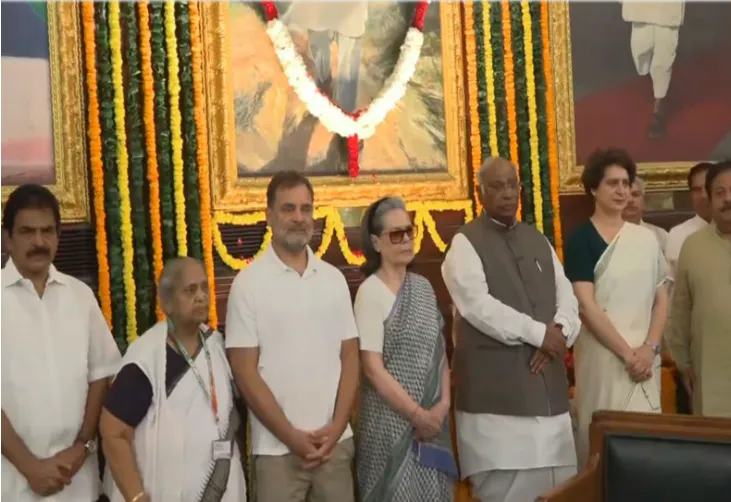
New Delhi, August 20: Top Congress leaders, including party president Mallikarjun Kharge, Leader of the Opposition in the Lok Sabha Rahul Gandhi, and Congress MP Priyanka Gandhi Vadra, paid floral tributes to former Prime Minister Rajiv Gandhi on his 82nd birth anniversary at the Central Hall of Samvidhan Sadan on Thursday.
Addressing the‘Hara Bhara Swaraj: A Tribute to Rajiv Gandhi’s Vision’event, Rahul Gandhi launched a sharp attack on corporate concentration and economic centralisation, drawing a distinction between democratic self-rule, or Swaraj, and monopolistic control.
“There’s no possibility of Swaraj for the large mass of Indian people if one man owns every single business in this country,” Rahul Gandhi said, arguing that economic opportunities and institutions should remain accessible to people across society.
Invoking Mahatma Gandhi’s vision of Swaraj, the Congress leader stressed the need for structural reforms to strengthen grassroots democracy. He said affordable education, a fair examination system, a decentralised financial structure and stronger democratic institutions were essential for achieving true self-rule.
Rahul Gandhi also underlined the importance of institutions ranging from Panchayati Raj bodies to elected representatives, saying democracy must reach deep into every part of the country.
Rajiv Gandhi became India’s youngest Prime Minister at the age of 40 after assuming office in October 1984, following the assassination of his mother and then Prime Minister Indira Gandhi. He remained Prime Minister until December 2, 1989.
Born on August 20, 1944, Rajiv Gandhi was assassinated by an LTTE suicide bomber during an election rally at Sriperumbudur in Tamil Nadu on May 21, 1991.
During his tenure, Rajiv Gandhi played a key role in promoting computerisation and information technology. His government reduced import duties on computers and software, helping lay the foundation for India’s growth as a major information technology hub. Policies introduced during his tenure also contributed to the development of the country’s software industry and the emergence of NASSCOM in 1988.
.webp)