
.webp)


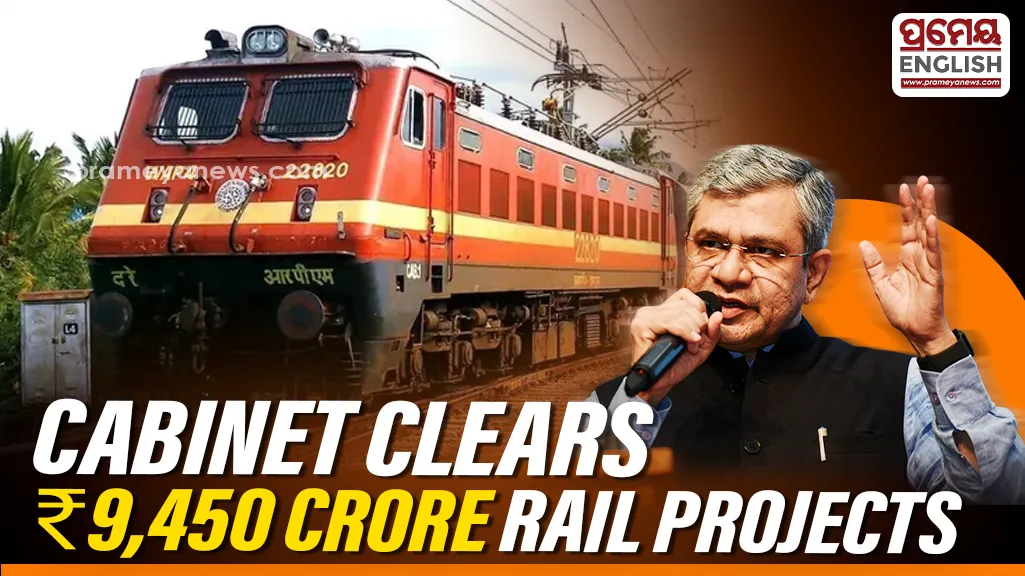
Delhi, August 19: The Cabinet Committee on Economic Affairs chaired by the Prime Minister Narendra Modi, on Wednesday approved four projects of Ministry of Railways with total cost of around Rs 9,450 crore, covering about 410 km across eight districts in West Bengal, Odisha, Tamil Nadu and Andhra Pradesh. The projects are targeted for completion by 2030-31.
These projects include, Kharagpur-Bhadrak (Ranital) 4th Line– 173 km (West Bengal and Odisha); Bhadrak-Haridaspur 4th Line – 75 km (Odisha); Gummidipundi-Gudur 3rd and 4th Line – 90 km (Andhra Pradesh and Tamil Nadu) and Cuttack-Paradeep (Badabandha) 3rd and 4th Line - 72 km (Odisha).
The increased line capacity will significantly enhance mobility, resulting in improved operational efficiency and service reliability for Indian Railways.
The projects are planned on PM-Gati Shakti National Master Plan with focus on enhancing multi-modal connectivity & logistic efficiency through integrated planning and stakeholder consultations. These projects will provide seamless connectivity for movement of people, goods, and services.
The proposed multi-tracking projects will enhance connectivity to approximately 6,448 villages, which are having a population of about 60 lakhs.
The proposed capacity enhancement will improve rail connectivity to several prominent tourist destinations across the country, including Kuldiha Wildlife Sanctuary, Bhitarkanika National Park, Maa Bhadrakali temple, Maa Dhamarai temple, Panchalingeswar Temple, Talsari–Udaypur and Chandipur Beach, Pulicat Lake, Nelapattu Bird Sanctuary, Lord Veeraraghava Perumal Temple, Gada Kujanga Jagannath Temple, Sarala Temple, Dhabaleswar Temple, Lalitgiri (a Buddhist site), etc.
The proposed projects are essential routes for transportation of commodities such as coal, iron ore, cement, iron and steel, container, automobile, food grains, etc. The capacity augmentation works will result in additional freight traffic of magnitude 76 MTPA (Million Tonnes Per Annum).
The Railways being environment friendly and energy efficient mode of transportation, will help both in achieving climate goals and minimizing logistics cost of the country, reduce oil import (~13 Crore Litres) and lower CO2 emissions (~65 Crore Kg) which is equivalent to plantation of 2.60 crore trees.
.webp)