



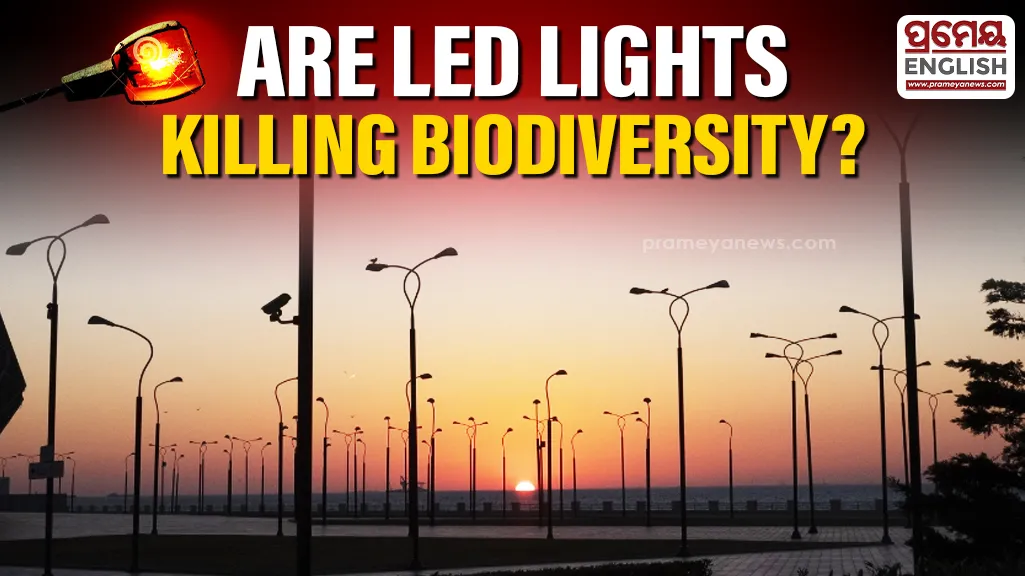
Bhubaneswar, May 25: Bats are disappearing, owl populations are under threat, and fireflies have become a rare sight. Moths and several nocturnal insects are gradually vanishing from urban landscapes. Scientists and environmental experts are now warning that excessive artificial lighting, particularly bright LED streetlights, is silently disturbing biodiversity and threatening the ecological balance in cities across Odisha.
From Bhubaneswar and Cuttack to Rourkela, Berhampur and Sambalpur, urban areas remain brightly illuminated throughout the night with high-intensity LED streetlights. While the lighting has improved visibility and urban aesthetics, experts say it is severely affecting insects, birds and other nocturnal creatures.
According to data from the Light Pollution Map, several parts of Bhubaneswar, including Chandrasekharpur, Patia and the Infocity region, are nearly 2700 per cent brighter than natural night conditions. Areas surrounding Chandaka Wildlife Sanctuary are reportedly witnessing 300 to 900 per cent higher brightness levels, while central localities such as Bapuji Nagar and Nayapalli remain around 1850 per cent brighter than normal night skies.
Environmentalists warn that such artificial illumination is disrupting the natural behaviour of insects and birds. Nocturnal insects, which generally navigate using moonlight, are getting disoriented by intense streetlights. Many insects mistake artificial lights for the moon and continuously circle around them until they become exhausted or die.
Professor Prabhat Sarangi from the Department of Entomology at Siksha 'O' Anusandhan University said the increasing brightness of urban lighting is directly linked to the growing death of insects. A research report prepared by postgraduate researcher Shubham Prakash Sahu highlighted that male insects are particularly attracted to bright lights, which affects their feeding and mating behaviour.
“As insects spend prolonged periods near artificial lights, they become weak and fail to search for food or mates. This is reducing their reproduction rate and disturbing pollination activities essential for plants,” the report noted.
Experts further stated that a decline in insect populations could seriously affect the food chain and overall biodiversity. Birds such as owls are moving away from brightly lit areas, while bats, known for consuming thousands of mosquitoes every hour, are rarely seen within Bhubaneswar city limits.
Professor Bibhuprasad Panda from the Department of Environmental Science at SOA University said excessive lighting from high-mast streetlights is also affecting birds’ sleep cycles, migration patterns and hormonal balance.
“Many migratory birds lose direction due to excessive urban illumination and often collide with tall buildings. Artificial lighting acts like an invisible wall for birds and insects during night-time movement,” he said.
Interestingly, experts pointed to international examples such as Copenhagen, where certain routes have replaced white streetlights with red lighting to minimise the impact on bats and insects.
Scientists have suggested that Odisha’s urban authorities should gradually replace white LED lights with yellow or red-toned lighting systems, especially near forests, water bodies and biodiversity-sensitive zones. They also recommended adopting smart lighting systems that automatically dim streetlights late at night to reduce ecological damage.
Environmentalists believe that unless immediate steps are taken, unchecked light pollution may severely impact pollination, decomposition processes and the natural balance of ecosystems in the coming years.