
.webp)

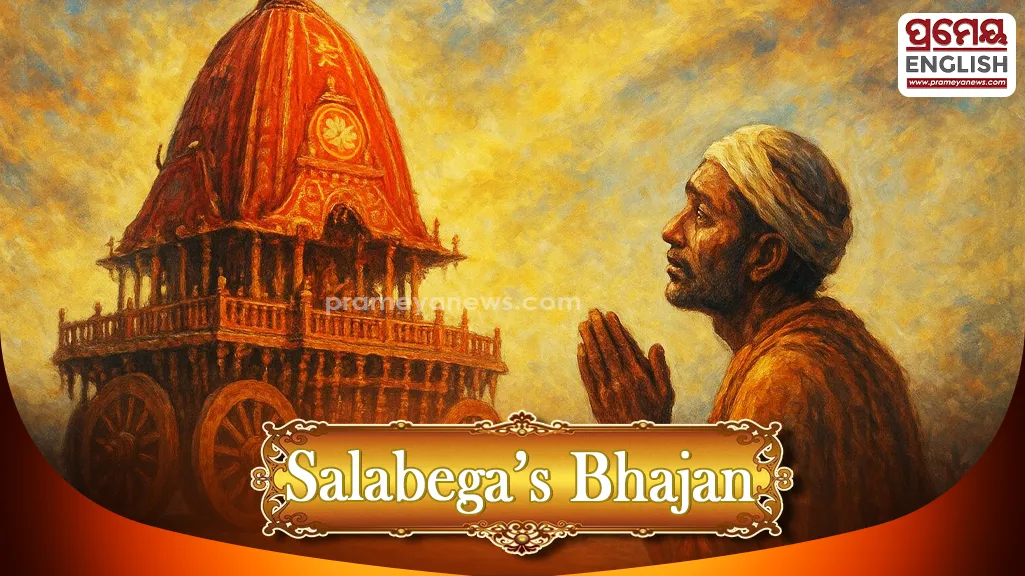
Puri, Jul 4: Every year during the world-famous Rath Yatra in Puri, millions witness a remarkable tradition. As Lord Jagannath's chariot rolls majestically along the Grand Road, it comes to a halt near Balagandi-not because of engineering or ritual delays, but in memory of a devotee who was never allowed to enter the Jagannath Temple.
That devotee was Salabega, the legendary poet-saint whose unwavering devotion continues to occupy a unique place in Jagannath culture centuries after his death.

A Devotee Born Between Two Faiths
According to historical accounts and Odia religious tradition, Salabega was born on September 16, 1592 (Radhashtami) in Cuttack. He was the son of Lalbeg, a military commander who served under Raja Man Singh in the Mughal army, and Lalita, a Brahmin widow from Danda Mukundpur near Pipili.
Lalita was reportedly taken away and married by Lalbeg. Although she was compelled to embrace Islam, she never abandoned her devotion to Lord Jagannath. She passed that spiritual legacy on to her son, planting the seeds of devotion that would later define Salabega's life.
A Near-Death Experience That Changed Everything
As a young man, Salabega accompanied his father in military campaigns after Lalbeg became the Subadar of Bengal during the reign of Emperor Jahangir.
During one of the battles against Afghan rebels, Lalbeg was killed while Salabega suffered life-threatening injuries. As his condition deteriorated, his mother sought the blessings of a Hindu saint, Bala Mukunda, who prayed for him and applied sacred ash to his forehead.
Traditional accounts state that Salabega recovered miraculously, an experience that transformed him into an ardent devotee of Lord Jagannath.
Rejected by Society, Accepted by the Lord

Salabega's growing devotion was not welcomed by either community. Many Muslims opposed his attachment to Jagannath, while orthodox sections of Hindu society refused to accept him because of his birth.
Determined to worship the Lord, Salabega travelled to Puri. However, he was denied entry into the Jagannath Temple and found no shelter in religious institutions or local households.
Undeterred, he built a humble hut made of palm leaves at Balagandi on the Grand Road, choosing to remain close to the Lord even from outside the temple walls.
The Miracle That Lives On
Legend says that during the Rath Yatra, the chariots of Lord Jagannath, Lord Balabhadra and Devi Subhadra stopped before Salabega's hut and refused to move until he arrived and offered his prayers.
Another popular tradition recounts that while returning from Vrindavan, Salabega fell seriously ill and realised he might not reach Puri before the Rath Yatra. He prayed earnestly to Lord Jagannath, requesting the Lord to wait for him.
When the chariot reached Balagandi, it is believed to have remained stationary until Salabega finally arrived and paid his obeisance. Ever since, the ceremonial halt of Lord Jagannath's chariot at Salabega's Samadhi has remained one of the most emotionally significant moments of the annual Rath Yatra.
The Devotee Who Protected the Temple

Historical narratives also credit Salabega with persuading Cuttack's Mughal Subadar, Mirza Ahmed Beg, to abandon an attack on the Jagannath Temple.
Recognising his devotion and service, the then Gajapati ruler is believed to have permitted Salabega to establish a permanent residence near Balagandi, which later became a revered spiritual centre visited by devotees from across the country.
Poet of Devotion
Salabega was not merely a devotee but one of Odisha's greatest devotional poets. He composed around 150 bhajans dedicated to Lord Jagannath, Radha-Krishna, Lord Shiva and Goddess Mangala.
Among them, "Ahe Nila Saila" remains one of the most beloved Jagannath bhajans ever composed. The hymn continues to resonate during Rath Yatra and is sung by devotees across Odisha, symbolising surrender, humility and unconditional devotion.
Samadhi That Receives the Lord's Blessings
Salabega spent the remainder of his life in Puri and is believed to have passed away in 1646. His Samadhi stands at Balagandi beside the Grand Road.
Centuries later, the tradition continues uninterrupted. Every Rath Yatra, Lord Jagannath's Nandighosa chariot pauses briefly before Salabega's Samadhi, reaffirming a timeless message—that in the eyes of the Lord, sincere devotion matters more than birth, caste or religion.
Salabega's life remains one of the most powerful examples of Odisha's inclusive Jagannath tradition, where faith triumphs over social barriers and devotion alone earns divine grace.
.webp)