
.webp)
Every year, as the majestic chariots of Lord Jagannath, Lord Balabhadra and Devi Subhadra roll down the Bada Danda in Puri, millions of eyes remain fixed on one of Rath Yatra's most iconic rituals—‘Chhera Pahanra’. Clad in royal attire, the Gajapati Maharaja of Puri ascends the chariots with a golden broom, sweeping the platform and sprinkling sandalwood-scented water. The ritual, performed by the king as the ‘Adya Sevak’ (First Servant) of Lord Jagannath, is a powerful reminder that before the Lord, every individual is equal.
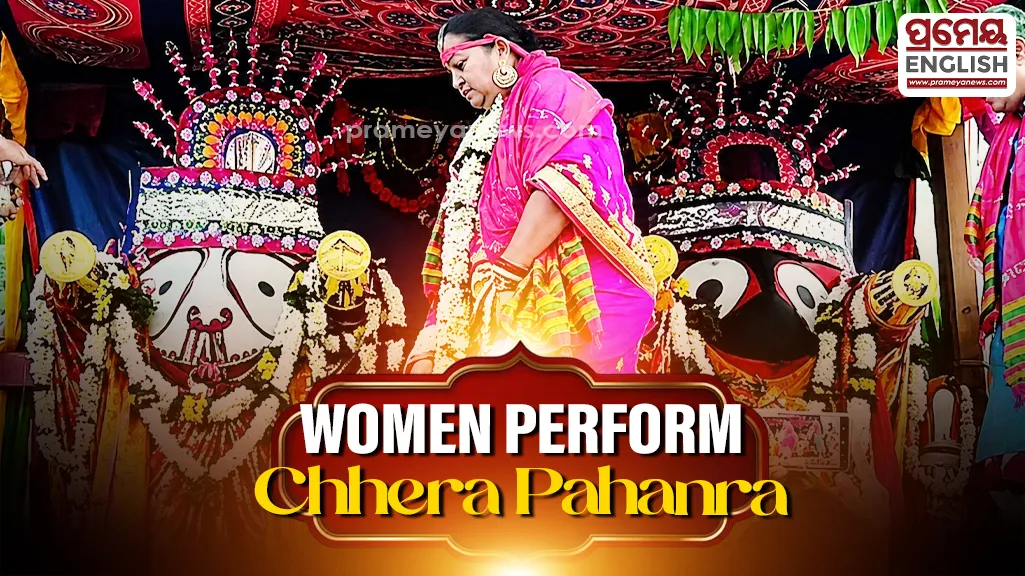
For many devotees, this is the only image they associate with Chhera Pahanra. Few know that in parts of Odisha, the sacred ritual has, for decades, been performed not by kings, but by queens.
Away from the spotlight of Puri, three Jagannath temples continue a remarkable tradition where women belonging to erstwhile royal families perform Chhera Pahanra. The temples at Dharakote in Ganjam district and ‘Gadamadhupur’ in Jajpur district preserve a legacy in which devotion and hereditary responsibility transcend gender.
Dharakote: A Princess who inherited a sacred duty
Among the best-known examples is the Jagannath Temple at Dharakote.
The tradition changed after the demise of Raja Jayananda Jagadeva in 2010. With no male successor, his daughter ‘Princess Sulakhyana (Gitanjali) Devi’ inherited the responsibilities of the royal household. Along with the royal estate came a sacred obligation—to perform Chhera Pahanra during Rath Yatra.
Since then, the princess has continued the centuries-old custom without interruption. Dressed in traditional royal attire, she ceremonially sweeps the chariots with the golden broom, just as her father once did.
Her participation challenged a long-held perception that the ritual is exclusively a man's privilege. In Dharakote, the right belongs to the head of the royal family, and not necessarily to a male heir.
Gadamadhupur: A queen upholding tradition
In the Jagannath Temple at Gadamadhupur in Jajpur district, **Queen Aparna Dhir Singh Bharadwaj** has become the face of another unique Rath Yatra tradition.
She began performing Chhera Pahanra in 2008 after succeeding her father as the head of the erstwhile royal family. Year after year, she performs the ritual with the same reverence that her predecessors displayed.
Speaking on previous occasions, the queen has maintained that her family's tradition never differentiated between sons and daughters when it came to preserving religious responsibilities. According to her, inheritance carried with it both privilege and duty, and Chhera Pahanra was one such sacred responsibility.
A different tradition, the same spirit
These three temples often invite curiosity because they differ from the practice followed at the Jagannath Temple in Puri.
In Puri, Chhera Pahanra is inseparably linked to the institution of the Gajapati Maharaja, who performs the ritual not as a ruler but as the foremost servant of Lord Jagannath. It is a unique temple tradition governed by centuries-old customs and hereditary rights.
The practices in Dharakote and Gadamadhupur do not alter or challenge the Puri tradition. Instead, they reflect how local Jagannath traditions evolved within the customs of individual royal families. In these former princely states, the ritual is performed by whoever succeeds as the head of the royal household, regardless of gender.
The common thread across all four traditions is not royal authority but humble service before the deity.
Devotion above distinction
The image of a woman holding the golden broom before Lord Jagannath quietly overturns many assumptions about temple traditions. Without slogans or campaigns, these royal women have demonstrated that devotion is measured by responsibility rather than gender.
Their participation also highlights the diversity within Odisha's Jagannath culture. While the rituals of Puri remain the spiritual benchmark for millions, the state's numerous Jagannath temples have nurtured their own customs over centuries, shaped by local history and royal patronage.
These traditions rarely make headlines. Yet every Rath Yatra, they continue to unfold with the same solemnity, drawing thousands of devotees who see no contradiction in a queen performing the sacred service reserved elsewhere for kings.
Preserving a living heritage
As Odisha celebrates Rath Yatra each year, the stories of Dharakote, Kujanga and Gadamadhupur remind us that the Jagannath tradition is both ancient and remarkably inclusive in its regional expressions.
The golden broom remains a symbol of humility. Whether held by a king in Puri or by a queen in these erstwhile princely states, its message remains unchanged—that before Lord Jagannath, every title, every privilege and every worldly distinction gives way to the spirit of selfless service.
These three temples stand as living examples of how heritage can adapt while preserving its essence. In their quiet corners of Odisha, queens continue to perform a ritual that has become one of the most enduring symbols of equality before the Lord, proving that in the service of Jagannath, devotion—not gender—is the true inheritance.
.webp)