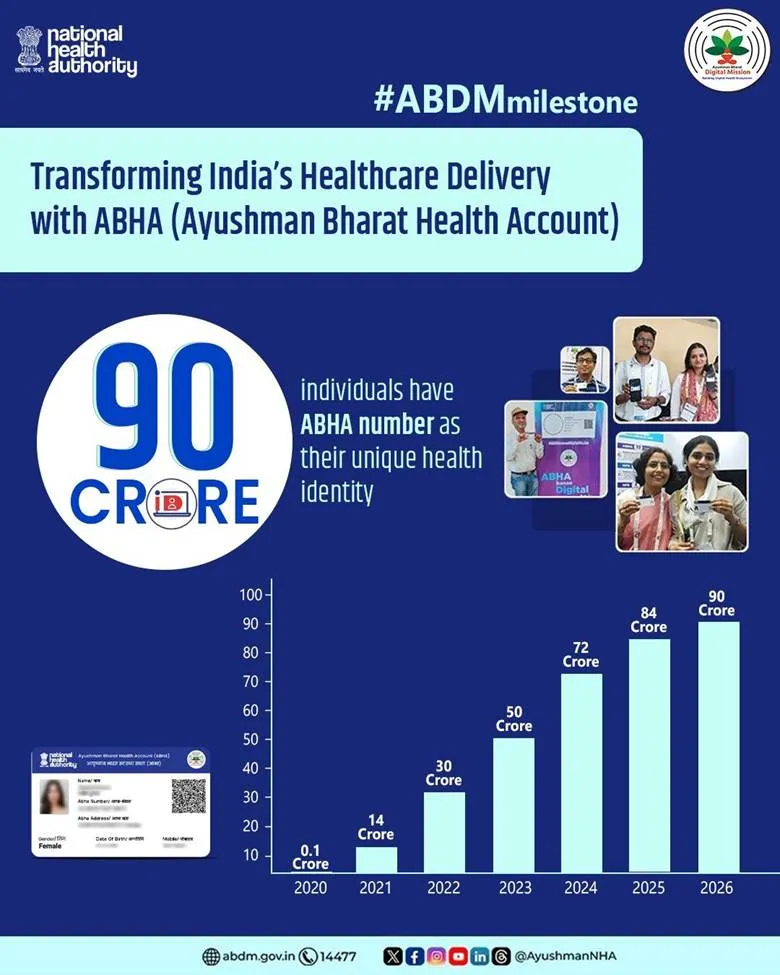
New Delhi, May 30: In a significant achievement towards building a digitally empowered healthcare ecosystem, the Ayushman Bharat Digital Mission (ABDM), implemented by the National Health Authority (NHA) under the Ministry of Health and Family Welfare, has crossed the landmark milestone of 90 crore Ayushman Bharat Health Accounts (ABHAs) across the country, an official statement said.
The achievement marks a major step in India's journey towards a connected, interoperable and citizen-centric digital health ecosystem.
ABHA is a unique 14-digit digital health identity that enables citizens to securely link, access and share their health records with their consent. As one of the key building blocks of ABDM, ABHA supports the creation of longitudinal health records across healthcare providers, facilities and digital health applications, empowering citizens with greater control over their health information.
The growth in ABHA creation has been consistent since the launch of ABDM. On a calendar year basis, cumulative ABHA creation increased from 14.7 crore in 2021 to 30.4 crore in 2022, 50.6 crore in 2023, 72.2 crore in 2024, and 84.5 crore in 2025, before crossing the 90 crore milestone in 2026.
Speaking on the achievement, Dr Sunil Kumar Barnwal, CEO, National Health Authority, said "The creation of over 90 crore ABHAs reflects the growing participation of citizens, States, UTs and ecosystem partners in the Ayushman Bharat Digital Mission. ABHA is an important step towards empowering citizens with secure, consent-based access to their own health information. As ABDM adoption deepens, ABHA will enable continuity of care, reduce dependence on physical records and support a more seamless, transparent and citizen-centric healthcare delivery system."
The milestone has been driven by strong participation from States and Union Territories across the country. Uttar Pradesh leads the nation with over 15.3 crore ABHAs, followed by Rajasthan and Maharashtra with 7.1 crore each, Bihar with 6.3 crore, and West Bengal with 5.9 crore ABHAs. Significant contributions have also come from Madhya Pradesh, Gujarat, Andhra Pradesh, Odisha and Karnataka, reflecting the nationwide adoption of digital health services.
Several States and Union Territories have also achieved high levels of ABHA saturation relative to their population. Andaman and Nicobar Islands, Ladakh, Lakshadweep, and Dadra and Nagar Haveli and Daman and Diu have achieved full saturation.
Among larger States and UTs, Andhra Pradesh has recorded 98.5% ABHA saturation, followed by Odisha (91.9%), Chandigarh (90.8%), Rajasthan (89.7%), Himachal Pradesh (88.9%), and Chhattisgarh (86.6%). Jammu and Kashmir, Tripura and Telangana have also achieved saturation levels exceeding 75 per cent.
The achievement also reflects growing participation of women in India's digital health ecosystem. Females account for nearly half of all ABHAs created, constituting 49.75% of total ABHA holders. This marks an important step towards empowering women, including those in rural areas, with secure digital access to their health records.
According to the Ministry of Health and Family Welfare release, ABHA can support continuity of care from the first point of contact with the health system, including maternal and child healthcare, immunisation and other essential health services.
The creation of over 90 crore ABHAs has been enabled through active collaboration between the Central Government, State Governments, healthcare providers and private-sector ecosystem partners. ABDM-enabled health-tech platforms, hospitals, diagnostic laboratories, insurers and digital health applications have played a key role in expanding ABHA creation through multiple channels, making digital health services more accessible to citizens.
ABDM is being implemented to establish a robust and interoperable digital health ecosystem across the country. Through key digital public infrastructure components such as the Ayushman Bharat Health Account (ABHA), Healthcare Professionals Registry (HPR), Health Facility Registry (HFR), Health Information Exchange and Consent Manager (HIE-CM), Unified Health Interface (UHI), and National Health Claims Exchange (NHCX), the Mission enables secure, consent-based and interoperable exchange of health information across the healthcare ecosystem.
For citizens, ABHA facilitates digital linking of health records generated across different healthcare facilities and applications, reducing the need to carry physical medical documents and enabling secure sharing of health information with healthcare providers whenever required and with consent. This strengthens continuity of care while improving efficiency, transparency and convenience in healthcare delivery.
The National Health Authority continues to work closely with States, Union Territories and ecosystem partners to accelerate ABDM adoption and ensure that citizens across the country benefit from a trusted, interoperable and digitally enabled healthcare ecosystem. (ANI)



.webp)
.webp)