

.webp)


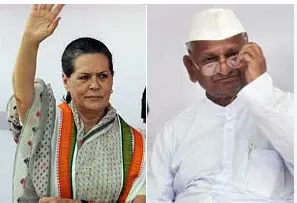
New Delhi, November 10: Congress Parliamentary Party (CPP) chairperson Sonia Gandhi has alleged that the 2012 anti-corruption movement led by social activist Anna Hazare was covertly organised and supported by the BJP and the RSS to bring down the Congress-led United Progressive Alliance (UPA) government.
In her memoir, Belonging: A Journey of Love, Sonia Gandhi recalled how the 'India Against Corruption' movement gained widespread public support and put the UPA government on the defensive.
According to an excerpt from the book, Hazare was brought to Delhi to launch a hunger strike demanding the appointment of a powerful Lokpal, an independent anti-corruption ombudsman. The protests attracted massive crowds, leaving the government struggling to counter what she described as an aggressive political campaign by the BJP.
Sonia Gandhi claimed that some prominent participants in the movement had subsequently acknowledged its covert backing by the BJP and RSS. She also said the protests eventually forced the UPA government to move forward with anti-corruption legislation.
The memoir further criticises the BJP government for allegedly sidelining the Lokpal institution after coming to power in 2014. Gandhi maintained that once the movement achieved its principal political objective of removing the UPA government, Anna Hazare and the campaign largely disappeared from public discourse.
Reflecting on the second term of the UPA government, she also defended former Prime Minister Manmohan Singh, saying he maintained his dignity despite what she described as a malicious media campaign. She recalled his remark that history would be kinder to him than the media.
The memoir also discusses the political developments ahead of the 2014 general elections, alleging that the RSS was preparing the ground for Narendra Modi, then Gujarat Chief Minister, to emerge as the BJP's prime ministerial candidate.
The Lokpal and Lokayuktas Act, 2013, received the President's assent on January 1, 2014. The legislation provides for a Lokpal at the Centre and Lokayuktas in states to investigate corruption allegations against public functionaries. The Lokpal comprises a chairperson and eight members, including four judicial members.
.webp)