


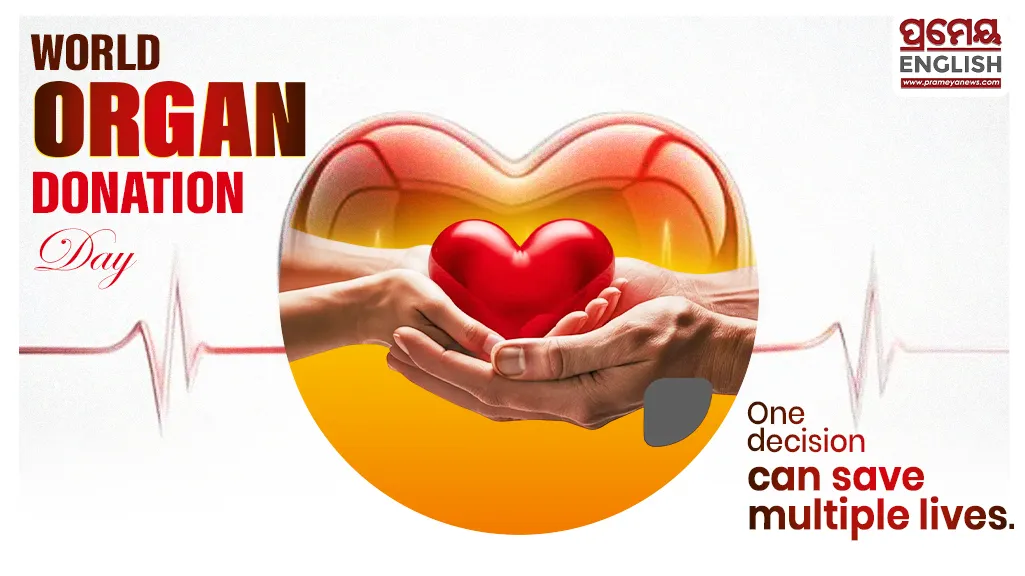
Bhubaneswar, August 13: Organ Donation Day is observed to create awareness about the importance of donating organs and tissues and to encourage people to make a pledge to donate. Organ donation is one of the greatest acts of humanity because a single donor can give several critically ill patients a chance to live a healthier and longer life.
In India, the need for organs is much greater than their availability. The Union Health Ministry has reported that India performed more than 18,900 organ transplants in 2024, yet thousands of patients continue to wait for organs such as kidneys, livers and hearts. The government has also emphasized that increasing awareness and reducing misconceptions are essential to expanding deceased-organ donation.
Why is Organ Donation Day celebrated?
Organ Donation Day is primarily celebrated to spread awareness about organ donation, remove myths and misconceptions, encourage people to pledge their organs and honour donor families. It reminds society that even after death, a person's life can continue through the lives of others.
There is an important distinction between two observances in India. World Organ Donation Day is observed on August 13, while Indian Organ Donation Day (IODD) is a separate national observance. NOTTO has traditionally observed IODD to commemorate India's first successful deceased-donor organ transplant, and the 15th IODD was held on August 2, 2025.
The significance of organ donation becomes particularly clear in cases of brain-stem death. When a person is declared brain-stem dead according to the prescribed medical and legal procedures, the family may consent to donation of suitable organs. These organs can then be allocated to patients on transplant waiting lists. The process is coordinated through organisations such as the State Organ and Tissue Transplant Organisation (SOTTO), regional organisations and NOTTO.
Why organ donation is important
1. It can save multiple lives: A deceased donor may provide several organs for transplantation. This means one family's decision during an extremely difficult moment can give hope to several other families.
2. It gives patients a second chance: For patients suffering from end-stage kidney, liver, heart or other organ failure, transplantation may be the most effective life-saving treatment.
3. It promotes social responsibility: Organ donation is an expression of compassion and solidarity. It shows that humanity can continue even in the face of personal loss.
4. It helps reduce the organ shortage: India continues to face a substantial gap between the number of patients requiring transplants and the number of organs available. Increasing deceased donation is one important way to bridge this gap.
5. It challenges myths: Many people hesitate because of misconceptions about age, illness, religion or what happens to the body after donation. Awareness campaigns help families make informed decisions.
Recent organ donation cases from Odisha
Odisha has witnessed several inspiring examples in recent years. These cases demonstrate how the courage of donor families, along with medical coordination, can transform tragedy into hope.
1. 16-month-old Janmesh Lenka — Odisha's youngest organ donor
In March 2025, 16-month-old Janmesh Lenka became Odisha's youngest reported organ donor. The child was admitted to AIIMS Bhubaneswar after a choking/foreign-body aspiration incident and was subsequently declared brain-stem dead on March 1. His parents, despite their immense grief, consented to organ donation.
His liver was retrieved and transported to the Institute of Liver and Biliary Sciences (ILBS), New Delhi, where it was transplanted into a child suffering from end-stage liver disease. His two kidneys were transplanted en bloc into a single adolescent recipient at AIIMS Bhubaneswar. The case was significant not only because Janmesh was the state's youngest donor but also because it involved a highly specialised paediatric en-bloc kidney transplant.
2. Six-year-old Swashri Ayan Patra — kidneys saved two lives
In May 2025, the family of six-year-old Swashri Ayan Patra made another remarkable decision. The child suffered a severe head injury after a heavy sliding gate fell on him at his home in Baripada. Despite medical treatment, he was declared brain dead at SUM Ultimate Medicare in Bhubaneswar.
After counselling by the medical team, his parents agreed to donate his kidneys. The kidneys were retrieved and sent to AIIMS Bhubaneswar and another private hospital, where they were used to help two critically ill children awaiting transplants. The hospital also accorded the young donor a guard of honour.
3. 14-year-old girl from Keonjhar — first Odisha donor to receive full state honours
In February 2024, a 14-year-old girl from Keonjhar became an important symbol of organ donation in Odisha. She had been suffering from chronic kidney disease and was undergoing dialysis before suffering a brain stroke. After she was declared brain dead at AIIMS Bhubaneswar, her parents consented to organ donation.
Her liver was retrieved and transported to ILBS, New Delhi, through a green corridor for transplantation. Her last rites were conducted at Swargadwar in Puri with full state honours, the first such recognition given to an organ donor in Odisha. The case also came soon after the state government's decision to recognise the sacrifice of organ donors and their families.
4. Dr Radha Parhi — a doctor's final gift in 2026
In April 2026, Dr Radha Parhi, a Homeopathic Medical Officer from Bhadrak district, became part of another landmark organ donation story in Odisha. She had pledged her organs during her lifetime. After she was declared brain-stem dead on April 2 following her death, her family honoured her wishes and consented to donation.
Her liver was retrieved and transplanted at AIIMS Bhubaneswar into a 46-year-old man suffering from serious liver disease. The successful surgery marked AIIMS Bhubaneswar's first deceased-donor liver transplant, an important milestone for Odisha's transplant programme.
Odisha's growing organ donation movement
These individual stories are part of a broader change in Odisha. AIIMS Bhubaneswar reported that its deceased-organ donation programme began in 2024, with further donations during the year involving kidneys and livers. The institution subsequently expanded its transplant capabilities.
The state has also used the Suraj Award to recognise families who consent to deceased-organ donation. The award is named after Suraj Behera, a brain-dead donor from Ganjam whose donated organs saved six lives. In 2025, Odisha honoured 24 donor families under the programme, with financial assistance of ₹5 lakh to each family.
Organ Donation Day therefore serves as a reminder: one decision, one family and one act of generosity can give another person the most precious gift of all—the gift of life.