
.webp)


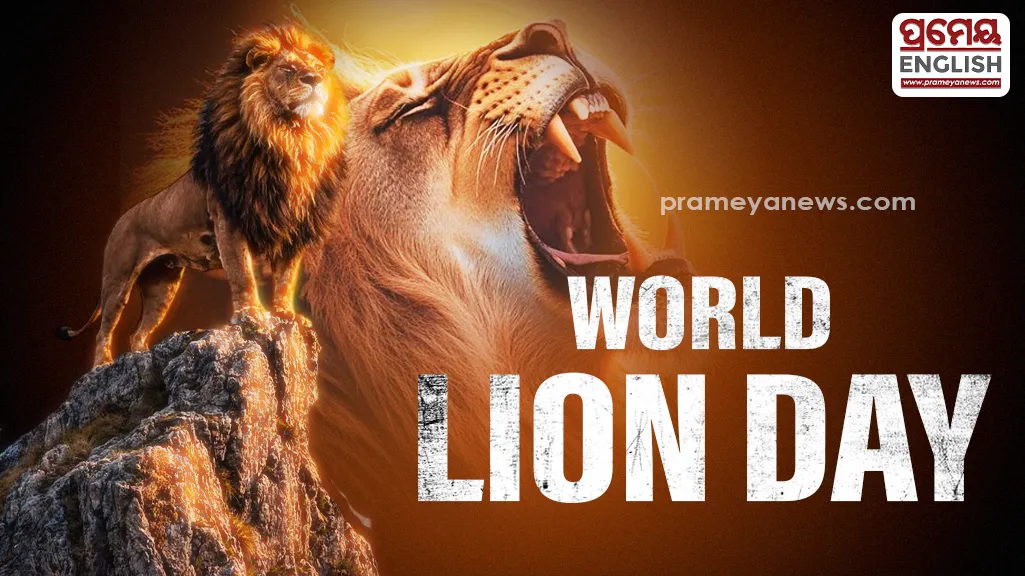
Bhubaneswar, August 10: The roar of a lion has long been associated with strength, courage and freedom. But behind that powerful roar lies a story of survival. Across the world, lions are facing growing pressure from habitat loss, declining prey, human-wildlife conflict and other threats. While wild populations struggle for space and survival, zoological parks have emerged as important centres for conservation, breeding and public awareness.
Every year, August 10 is observed as World Lion Day, providing an opportunity to celebrate the magnificent big cat and, more importantly, to reflect on the challenges confronting its survival.
For Odisha, the story of lion conservation has a special connection with Nandankanan Zoological Park near Bhubaneswar, where efforts have been continuing for years to maintain and increase the captive lion population.
From celebration to conservation
World Lion Day was first observed on August 10, 2013. The initiative is associated with conservationists Dereck and Beverly Joubert, who worked with National Geographic and the Big Cat Initiative to draw global attention to the declining populations of lions and other big cats.
Since then, World Lion Day has become an important occasion for wildlife organisations, zoos, conservationists, schools and animal lovers to spread awareness about the importance of protecting lions.
The significance of the day goes far beyond celebrating the lion as a symbol of power. Lions are apex predators and their presence plays an important role in maintaining ecological balance. By controlling populations of herbivores and other prey animals, they contribute to the health of the ecosystems in which they live.
But the future of lions is under pressure. Habitat destruction and fragmentation, declining prey populations, human-wildlife conflict and illegal killing are among the major challenges facing the species. Protecting lions, therefore, also means protecting forests, grasslands, prey species and the communities that share these landscapes.
Nandankanan's Lion Story
In Odisha, Nandankanan Zoological Park has become an important name in the conservation and captive breeding of lions.
There was a time when more than 50 lions were housed at Nandankanan. The large population led to the establishment of the Lion Safari, which became one of the major attractions of the zoological park.
However, the lion population subsequently declined. Questions have been raised about management decisions and other factors that may have contributed to the reduction. Today, the challenge before the authorities is not merely to increase the number of lions, but to ensure that the population remains healthy, genetically diverse and sustainable.
Nandankanan began renewed efforts towards lion population management in 2020, when there were around 10 lions and lionesses.
On March 17, 2020, four lions—Basanta, Samrat, Jaya and Sarat—were brought from Bilaspur Zoo. Later, on December 20, 2020, two lionesses, Bijili and Rewa, arrived from Kamla Nehru Zoological Park, Indore.
These additions were intended to strengthen the breeding programme and provide a wider genetic base for the captive population.
A Story of Birth, Hope and Loss
The breeding programme has produced encouraging results, but it has also highlighted the difficulties involved in raising endangered and genetically valuable animals in captivity.
Lioness Bijili, after mating with lion Samrat, gave birth to 13 cubs in four litters. Similarly, lioness Rewa, after mating with lion Jit, produced eight cubs in three litters.
These births brought hope to Nandankanan's conservation programme. But not every cub survived. Some died, while others were transferred to different zoos under animal-exchange programmes.
Another challenge has emerged with some newborn cubs. In certain cases, lionesses have not accepted or adequately cared for their cubs. Such cubs have to be separated and raised at the zoo's hand-rearing or infant-care centre, where they receive specialised care.
Despite the best efforts of keepers and veterinarians, some cubs do not survive. Each such loss is a setback for a breeding programme in which every animal can be important for the future genetic health of the population.
23 lions: A small rise, a bigger challenge
According to the latest figures cited in the report, Nandankanan's lion population has increased from 22 last year to 23 this year—an increase of just one animal.
Of the 23 lions, 17 are Asiatic lions and six are hybrids.
On the surface, an increase from 22 to 23 may appear modest. But captive breeding is not simply a numbers game. The real objective is to maintain a healthy, genetically diverse and viable population.
For this reason, Nandankanan authorities are also looking at exchanges with other zoos. Bringing in lions from different institutions can help reduce the risk of inbreeding and introduce genetic diversity into the captive population.
Thus, every birth, death, transfer and exchange becomes part of a larger conservation strategy.
## When the Lion Safari Became a Reminder
The Lion Safari at Nandankanan was established at a time when the zoo had a population of more than 50 lions. Today, the decline in numbers has given the safari a different significance.
It is no longer simply a place where visitors come to see lions. It can also serve as a reminder of how fragile animal populations can become when conservation efforts face biological, environmental and management challenges.
A lion behind a fence may appear safe, but captive conservation itself is a complex responsibility. Animals need proper nutrition, veterinary care, suitable enclosures, successful breeding, genetic management and, when necessary, specialised hand-rearing.
The ultimate purpose should be to ensure that future generations can continue to see the lion—not merely in photographs, documentaries or history books, but as a living species that continues to have a place in nature.
Taking the Message Beyond the Zoo
World Lion Day also provides Nandankanan with an opportunity to take conservation messages beyond its gates.
This year, the zoo authorities have announced a World Lion Day programme at Mundamuhan Government High School under Kuhneipada Gram Panchayat in Baranga Block.
The programme will focus on creating awareness about lion conservation and captive breeding. Students will participate in activities such as drawing and quiz competitions, with prizes for the winners.
Such programmes are important because conservation cannot depend solely on zoos, forest departments or wildlife experts. Young people and local communities must also understand why wildlife protection matters.
More Than Just a Number
The increase from 22 to 23 lions at Nandankanan may seem small, but behind that single number lies a much bigger story—a story of breeding, births, deaths, transfers, veterinary care and efforts to maintain genetic diversity.
It is also a reminder that conservation success should not always be measured simply by counting animals.
The real question is whether we can create conditions in which populations remain healthy, genetically diverse and capable of surviving in the long term.
On World Lion Day, the world celebrates the roar of the lion. But conservation is about ensuring that the roar does not become a memory.
For Nandankanan, the challenge is clear: not just to have more lions, but to build a healthy and sustainable lion population for the future.
And for all of us, the message of World Lion Day is equally clear—protect the lion, protect its habitat and protect the ecological balance that makes its survival possible.**
.webp)