


Subrat Kumar Pati’s Ground Report from Dibrugarh, Assam
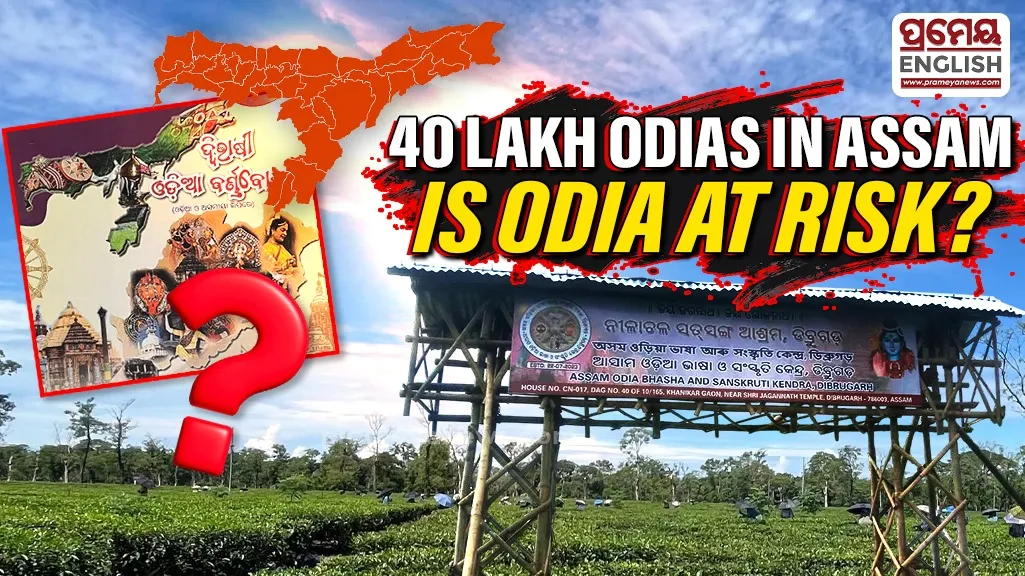
Rama Chandra Sasoni knows the name of his ancestral village in Odisha-Athagarh Khuntuni.But that is almost all that connects him to the place from where his forefathers began their journey to Assam generations ago.Sasoni has never visited the village. He has never seen the house where his ancestors lived. His family came to Assam when his forefathers were recruited to work in the tea gardens. Generations later, Assam is home.

Today, Sasoni lives in Assam with his wife, Nomoli, and their two daughters. He is the president of the Assam Odia Bhasa o Sanskruti Kendra and is now working to preserve the language and culture of the community to which his family once belonged.
His personal story reflects a much larger question confronting Assam's Odia-origin population:
Can a community retain its ancestral language after living away from its homeland for nearly two centuries?
The story began with the expansion of Assam's tea industry in the nineteenth century.

The British developed commercial tea plantations in Assam and soon faced a severe shortage of plantation labour. Workers were brought from different parts of present-day Odisha, Jharkhand, West Bengal, Bihar, Chhattisgarh and other regions.
Large-scale recruitment of outside labour for Assam's tea plantations expanded from around the 1860s. The colonial plantation system depended heavily on this migrant workforce, and recruitment was often carried out through intermediaries under difficult and exploitative conditions.
Odisha's Na-Anka Durbhiksha of 1866 further intensified distress and migration from the state. Famine, poverty and lack of livelihood pushed many people to leave their villages in search of survival.For thousands of families, the journey to Assam was supposed to be temporary.
It wasn't.They settled down in the tea gardens.Their children were born in Assam.Their grandchildren grew up in Assam.Eventually, the tea gardens became their home.
The migration that began nearly two centuries ago therefore created one of the largest communities of people of Odisha origin outside Odisha.
Nearly 40 lakh — but how many still speak Odia?
According to unofficial estimates cited by community organisations, nearly 40 lakh people of Odia origin are living across Assam.But the figure needs an important qualification.The 40-lakh estimate does not mean that 40 lakh people currently speak Odia as their mother tongue.

In fact, the last Census presents a dramatically different picture.The 2011 Census recorded 2,18,552 people in Assam who reported Odia as their mother tongue.The difference between the two figures is significant.
It indicates that a large section of the people whose ancestors migrated from Odisha no longer identify Odia as their mother tongue. Many have gradually shifted to Assamese, Sadri and other languages commonly spoken in the tea-garden communities.Thus, the question is not simply how many people of Odia origin live in Assam.
How much of their ancestral language remains with them?
The communities that emerged in Assam's tea gardens were themselves extremely diverse.Workers came from different regions and spoke different languages. Over generations, a common linguistic environment developed in the plantations. Sadri and other forms of tea-garden speech became important means of communication, while Assamese, Hindi, Bengali, Odia and several tribal languages continued to be used within different communities.
This multilingual environment helped create a distinct tea-garden identity.But it also created a challenge for the preservation of individual mother tongues.For many descendants of Odia migrants, Odia gradually became a language associated with their ancestors rather than everyday life.

At home, children often heard other languages.At school, they encountered another.Outside the family, there was little practical necessity to learn Odia.Slowly, the language began to retreat from everyday life.
The man who decided to do something
Jnana Ranjan Sahoo arrived in Assam from Bhubaneswar in 2022.As an engineer, he had come to Assam for professional reasons. But during his stay, he came across a community whose history immediately caught his attention.
They were people of Odisha origin.They had been living in Assam for generations.But many could neither speak nor write Odia.Sahoo began visiting different tea estates and interacting with families.What he saw convinced him that the problem was larger than he had initially imagined.
Many children knew that their ancestors had come from Odisha. They knew that Odia was their ancestral language.But they had little opportunity to learn it.Sahoo decided that simply talking about the decline of Odia would not help.He began working to create places where children could actually learn the language.Thus began the Odia Pathadana Kendra initiative.
Small classrooms, a big mission
Odia language-learning centres were established at places including South Jalan Nagar, Mohanbari, Baughpara, Chabua, Sealkoti and Mukulbari.The model was different from a conventional school.Sahoo first trained local people.Those people subsequently became teachers.The idea was simple: a language movement in a community can survive only when the community itself becomes responsible for teaching the language.The centres are therefore not merely classrooms.They are attempts to reconnect children with a language that their grandparents or great-grandparents may once have spoken naturally.For some families, learning to write Odia is the first formal contact their children have had with the language of their ancestors.

Damodar Panda, an engineer working in central government service in Assam, joined the organisation after arriving in the state in 2024 and became its secretary.He is now involved in expanding the language-learning initiative.The organisation is trying to promote not only Odia language but also the culture and traditions associated with Odisha.
It has published bilingual language-learning books and is working to establish more learning centres and train additional teachers.Panda's wife, Anita Panda, is also teaching at some of the centres.The effort remains largely community-driven.There is no large institutional structure behind these classrooms.Instead, a small group of people is trying to build a network of teachers, volunteers and learners across the tea-garden belt.
At Mukulbari and Nadua, the teachers themselves tell another part of the story.Gourishankar Patnayak is a Class XII student.Yet after attending his own classes, he spends time teaching Odia to younger learners at the Mukulbari and Nadua centres.
Paraswar Tanti works as a receptionist at a hotel.His job keeps him occupied, but he still finds time to contribute as a voluntary teacher at the Nadua-Mukulbari centre. Like 6 more teachers are presently involved in this language learning centres.Neither is a professional language teacher.But they believe that preserving a language requires personal involvement.Their classrooms are modest.Their students are few.But their work represents a larger battle taking place quietly across Assam's tea belt.
Assam's multilingual education challenge
The problem is not unique to Odia.Assam's tea-garden communities include people with diverse linguistic and cultural backgrounds. The state has itself recognised the challenge of educating children whose home language may be different from the language used in school.

Government programmes have attempted to bridge the gap between children's home languages and Assamese, particularly in tea-garden areas. Assam has also been expanding Tea Garden Model Schools.Recent educational initiatives have increasingly recognised the importance of multilingual education in the state.
For the Odia-origin community, however, the demand is more specific: they want their children to have a structured opportunity to learn their ancestral language.Community representatives have sought greater recognition for Odia in educational institutions serving tea-garden communities.The demand is not necessarily about replacing Assamese.It is about adding another language to the educational and cultural space.
The language that disappears quietly
Language loss rarely happens in a single generation.First, children stop speaking the language with their friends.Then they begin responding to their parents in another language.Reading becomes difficult.Writing becomes unfamiliar.The language survives in songs, festivals, names and memories.Eventually, even those connections become weaker.That is why the story of Assam's Odia-origin population is not simply a story of migration.
It is also a story of assimilation.A family can retain its surname.It can remember the village from which its ancestors came.It can celebrate festivals associated with Odisha.But if its children cannot speak or read Odia, an important part of that heritage is already disappearing.
The 40-lakh question
The estimate of nearly 40 lakh people of Odia origin in Assam and the Census figure of just 2.18 lakh Odia mother-tongue speakers should not be read as contradictory population counts.
They measure different things.One is an unofficial estimate of a community's broader ancestral identity.The other is an official Census count based on the language people reported as their mother tongue.But the gap between the two figures raises an important question.If such a large population has roots in Odisha, why has Odia ceased to be the mother tongue for so many of them?
The answer lies in nearly two centuries of migration, settlement, inter-community marriage, multilingual education, economic mobility and cultural assimilation.And that makes the language campaign now underway in Dibrugarh and other tea-garden areas particularly significant.
A journey in reverse
Nearly two centuries ago, migration carried workers from Odisha to Assam.Today, another kind of journey is taking place.A few culture loving Odias are travelling through tea-garden communities, carrying books instead of labour contracts and language lessons instead of recruitment messages.They are not asking people to return to Odisha.They are not questioning their identity as Assamese residents.They are simply trying to ensure that being settled in Assam does not mean forgetting the language of their ancestors.The task is enormous.The classrooms are small.The number of volunteers is limited.And the forces of linguistic assimilation are much stronger.
But every child who learns to read an Odia sentence, every volunteer who teaches an alphabet and every family that begins speaking Odia at home adds another link to a chain that stretches back nearly two centuries.

The question, therefore, is not whether the people of Odia origin in Assam will remain connected to Odisha.Many already have a new home in Assam.The real question is whether Odia will remain part of their inheritance.And in the tea gardens of Dibrugarh, the answer may be decided not by the generation that migrated from Odisha, but by the children who are growing up there today.