



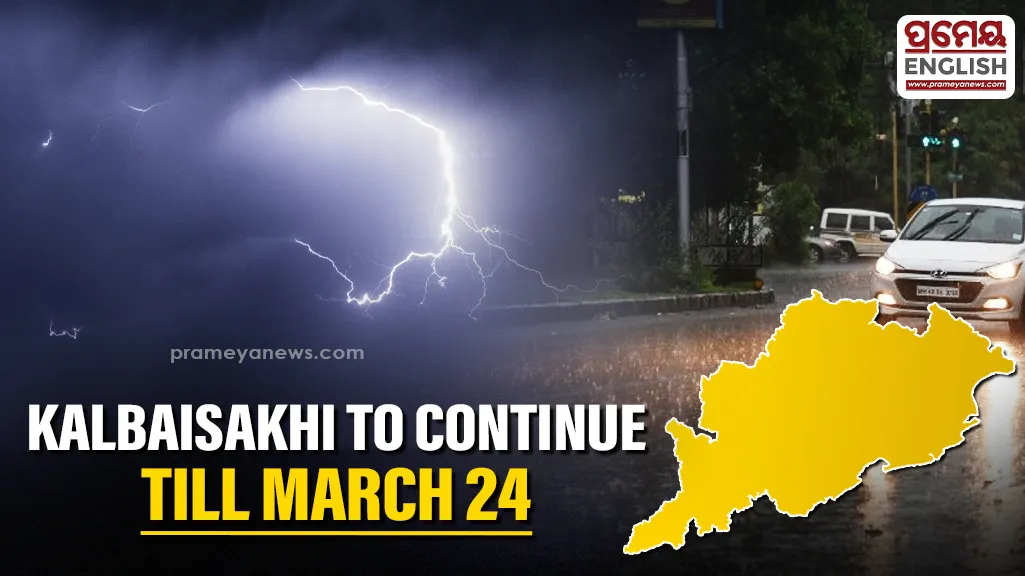
Bhubaneswar, March 19: The impact of Kalbaisakhi is set to continue across Odisha till March 24, bringing rain, thunderstorms and gusty winds to several parts of the state.
According to the India Meteorological Department’s Bhubaneswar Meteorological Centre, various districts are likely to experience light to moderate rainfall accompanied by lightning and wind speeds of 30–40 kmph over the next few days. However, there will be no significant change in the prevailing heat conditions during the next 24 hours. Thereafter, the day temperature is expected to drop by 2 to 3 degrees Celsius and remain stable for the following five days.
Districts such as Puri, Khordha, Ganjam, Kalahandi, Koraput, Balasore, Cuttack and Mayurbhanj are among those likely to receive rainfall or thunderstorms at one or two places.
Meanwhile, southern districts including Nabarangpur and Kalahandi may witness more intense thunderstorm activity with heavy showers at isolated locations. Similar weather conditions are also expected in Rayagada, Gajapati and Malkangiri.
On Wednesday, the maximum temperature across the state remained between 34°C and 36°C. Chandbali recorded 36.4°C, while Talcher registered 36.5°C. The state capital Bhubaneswar recorded 34.7°C, while Cuttack reported 34.2°C.