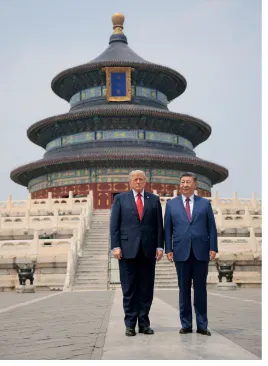
Beijing, May 14 : Extending an invitation for a reciprocal visit, US President Donald Trump has invited Chinese leader Xi Jinping and First Lady Peng Liyuan to the White House for a summit scheduled for September 24.
This diplomatic gesture served as a focal point during the US President's address in Beijing, where he lauded the bond between the two superpowers. Trump observed that the citizens of both nations "have a deep sense of mutual respect," while expressing his gratitude for the "magnificent welcome" he received upon commencing his historic state visit.
Reflecting on his high-level deliberations with his counterpart, the 79-year-old leader remarked, "We had an extremely positive and constructive discussion today."
Warmth between the two leaders was evident at the state banquet hosted by the Chinese side, where Trump affectionately referred to the Chinese president as "my friend" during his opening remarks. He traced the lineage of the bilateral relationship back to the very founding of the United States, recalling how early American traders arriving in China were aptly described by their hosts as "the new people."
Framing the modern partnership in a global context, Trump asserted that contemporary ties have evolved to become among "the most consequential" in the world. As he brought his speech to a close, the US President reaffirmed his desire for continued engagement by inviting Xi and his wife to Washington this coming September.
This promise of future hospitality followed a homecoming of sorts, as President Trump returned to China after nearly a decade. His arrival initiated a diplomatic encounter of intense global scrutiny, anchored by an exhibition of ceremonial grandeur at the Great Hall of the People.
Amidst the sprawling red-carpet reception, Chinese leader Xi Jinping greeted the US President with full military honours as the US national anthem echoed through the hall. The atmosphere was further enlivened by the high-spirited cheers of schoolchildren waving colourful pompoms--a meticulously choreographed display of warmth that served as a wholesome prelude to a summit focused on the weighty complexities of trade, technology, and Taiwan.
As the two leaders moved into formal deliberations, Xi observed that the international community is currently navigating "profound changes." He issued a poignant caution regarding the "Thucydides Trap," the historical theory suggesting that friction between emerging and established powers often precipitates conflict.
Advocating for a relationship defined by stability, Xi asserted that Washington and Beijing must act as "partners, not rivals." He noted that the two powers possess "more common interests than differences" as he called for a "new chapter" in their shared history.
Mirroring this optimistic sentiment, President Trump lauded his counterpart as a "great leader," projecting that the bilateral bond would soon be "better than ever before." Accompanied by a high-powered delegation of American corporate and technology titans, Trump emphasised their readiness to broaden trade and investment horizons within China.
Characterising the high-stakes meeting as "maybe the biggest ever," he expressed firm confidence in the potential for these talks to fundamentally recalibrate the global economy.
The engagement unfolded against a complex geopolitical backdrop, including the ongoing Iran conflict and escalating domestic pressure in Washington, where internal Republican Party debates over Middle Eastern military involvement continue to intensify.


.webp)


.webp)