


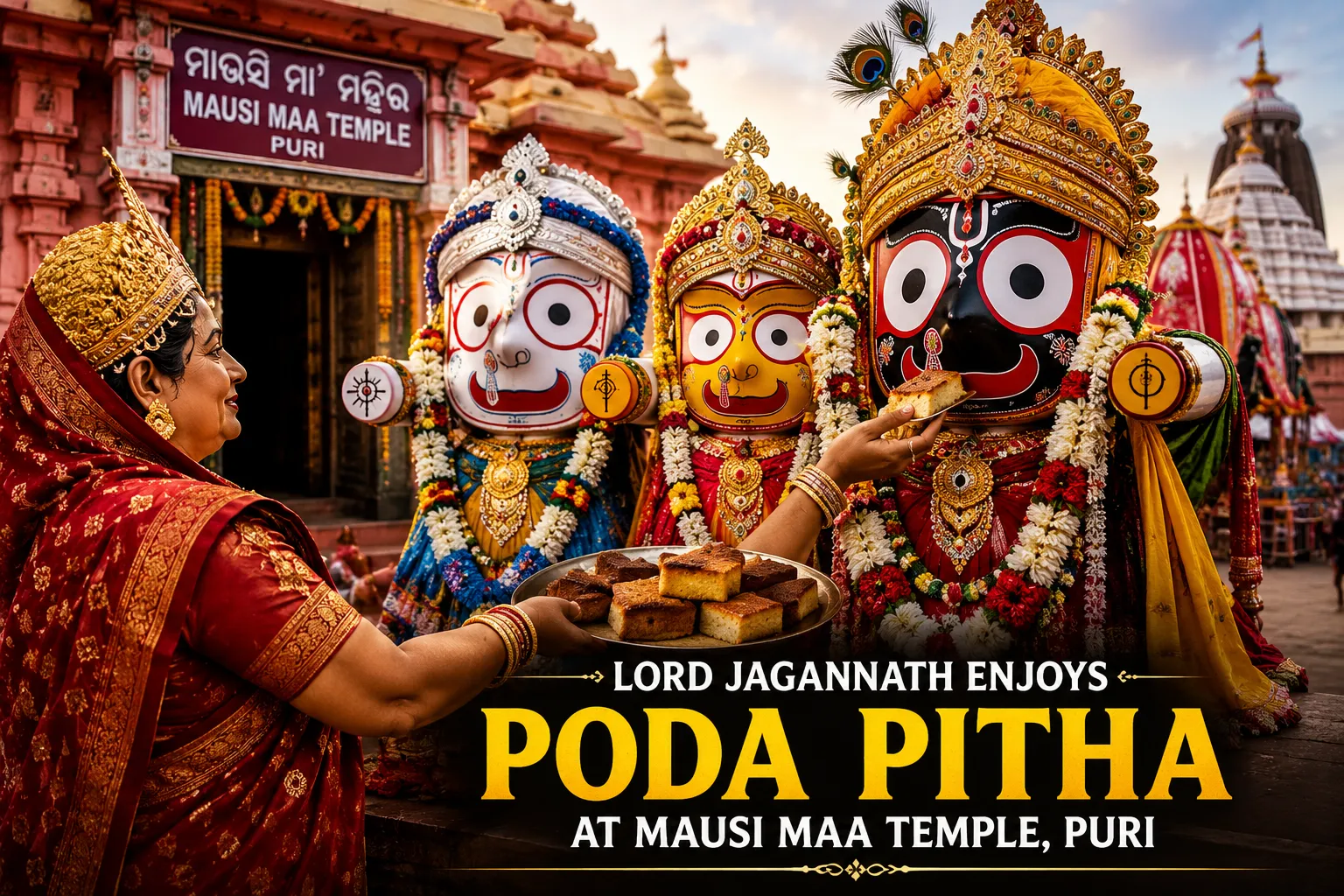
Puri, Jul 11: During Bahuda Yatra, the return journey of Lord Jagannath, Lord Balabhadra and Devi Subhadra from the Gundicha Temple to the Shree Jagannath Temple, the deities are traditionally offered Poda Pitha, a beloved Odia delicacy, before continuing the journey back to his abode.
Poda Pitha, one of Odisha's most iconic traditional sweets, is prepared using rice, jaggery, coconut and lentils. Unlike ordinary cakes, it is slowly baked until it develops a rich caramelised crust, giving it a distinctive smoky flavour. This humble yet sacred offering has become an inseparable part of the Bahuda Yatra, symbolising affection, hospitality and devotion.

The ritual is rooted in ancient legends. According to one popular belief, during the Ramayana, Bharat reproached his mother Kaikeyi for sending Lord Rama into exile. Overwhelmed with guilt, Kaikeyi wept in remorse. To console her, Lord Rama promised that in his next incarnation, he would visit her home and accept her offering of Poda Pitha. Devotees believe that Kaikeyi was later reborn as Lord Jagannath's maternal aunt, and the Mausi Maa Temple represents her residence. Every year during Bahuda Yatra, Lord Jagannath fulfils this divine promise by stopping at the temple to partake of the sacred offering.
Another widely accepted tradition associates the Gundicha Temple with Queen Gundicha, the devoted consort of King Indradyumna, who is credited with establishing the Jagannath Temple. Pleased by her unwavering devotion, Lord Jagannath is believed to have promised to visit her residence once every year. This annual stay at the Gundicha Temple during the Rath Yatra commemorates that divine assurance. A parallel folk tradition also reveres Gundicha as the Lord's loving aunt, who welcomes her nephews with warmth and affection during their annual visit.
After spending a week at the Gundicha Temple, the deities begin their return journey on the tenth day of the festival. As the three majestic chariots retrace their path, they halt briefly at the Mausi Maa Temple, also known as the Ardhasani Temple. Here, the deities are ceremonially offered Poda Pitha before resuming their journey towards the Shree Jagannath Temple.
The Bahuda Yatra follows the same grandeur and rituals as the outward Rath Yatra. Devotees believe that pulling the ropes of the chariots, touching them, or even assisting others in doing so earns immense spiritual merit, equivalent to performing several penances. Every object associated with the Rath Yatra is regarded as sacred and inseparable from the divine presence of Lord Jagannath.
Following the offering at the Mausi Maa Temple, the chariots of Lord Balabhadra and Devi Subhadra proceed to the Singhadwara, the Lion's Gate of the Jagannath Temple. Lord Jagannath's chariot pauses briefly near the royal palace, where Goddess Lakshmi is believed to catch a glimpse of her returning consort from the Chahani Mandapa. She later visits the Lord's chariot in a palanquin, offers him a garland as a token of love, and returns to the temple, paving the way for his ceremonial re-entry into the sanctum.
The Rath Yatra also stands apart for its inclusivity. During the deities' stay at the Gundicha Temple, people of all faiths, including non-Hindus and foreign visitors who cannot enter the main Jagannath Temple, are allowed to have darshan of the deities and receive the sacred offerings. This unique tradition reflects Lord Jagannath's universal appeal as the Lord of the Universe.
For millions of devotees, the offering of Poda Pitha at the Mausi Maa Temple is much more than a culinary tradition. It represents the fulfilment of an eternal promise, the affection of a maternal aunt, and the deep bond between the Lord and his devotees. The simple baked delicacy has thus become one of the most meaningful symbols of Odisha's spiritual heritage and the timeless traditions of the Jagannath culture.