
.webp)


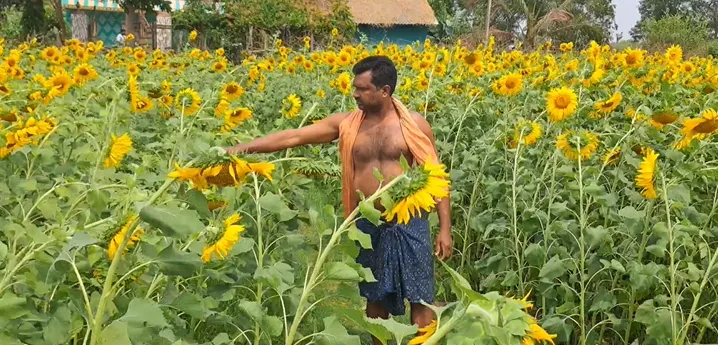
Anandapur, Jun 1: In a remarkable example of self-reliant farming, villagers of Chamaratira under Salania Panchayat in Hatadihi block of Keonjhar district have been cultivating sunflowers for the past decade, producing pure sunflower oil for household consumption and earning additional income by selling the surplus in the market.
Chamaratira, a small village comprising barely 15 to 20 farming families, has transformed its agricultural landscape by introducing sunflower cultivation after the paddy harvest season. Instead of leaving their fields fallow after harvesting paddy in December, farmers sow sunflower seeds sourced from neighboring Bhadrak district. Within just two to three months, the crop is ready to harvest, providing an additional source of income and nutrition.
The cultivation process is simple and cost-effective. After preparing the land through ploughing, farmers sow sunflower seeds and apply fertilizers only once or twice during the crop cycle. Flowers begin appearing within a month, and mature heads are harvested after about two months. The seeds are then processed through oil extraction machines in nearby markets to produce pure sunflower oil.
According to local farmers, seeds obtained from four sunflower heads weigh approximately one kilogram, yielding around 400 millilitres of oil. After meeting their family's annual cooking oil requirements, farmers sell the excess oil at around ₹170 per litre. The demand for the chemical-free, locally produced oil is so high that traders and consumers often visit farmers' homes directly to purchase it.
The benefits extend beyond oil production. The residual sunflower cake left after oil extraction is widely used as animal and fish feed. Fish farmers, in particular, prefer the by-product as it is believed to promote faster fish growth, creating an additional revenue stream for cultivators.
Farmers also highlight the environmental advantages of sunflower cultivation. Since only the flower heads are harvested, the remaining plant matter decomposes naturally and enriches the soil, improving fertility for the next paddy crop. The crop is relatively resistant to pests and diseases, with birds posing the primary threat during flowering. Farmers manage this challenge by covering fields with protective nets.
Despite successfully practicing sunflower cultivation through their own initiative for nearly ten years, villagers allege that they have received little government support. They claim there is no assistance in the form of quality seeds, technical guidance, or assured market linkages.
Responding to these concerns, Anandapur District Agriculture Officer Neelamadhab Dash said the matter would be discussed with higher authorities to explore the possibility of extending government incentives and support to sunflower growers from the next cultivation season.
For the farmers of Chamaratira, sunflower cultivation has become more than just a crop—it is a sustainable model of rural entrepreneurship, ensuring household food security while generating additional income from every harvest.
.webp)