
.webp)


The brutal killing of Graham Staines and his sons, Philip and Timothy, shocked India and the international community, becoming one of the most widely discussed incidents of religious violence in the country.
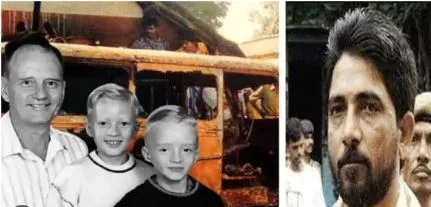
 On the night of January 22-23, 1999, Australian missionary Graham Staines, who had spent decades serving leprosy patients and tribal communities in Odisha, was sleeping inside a station wagon in Manoharpur village of Keonjhar district along with his two sons, Philip (10) and Timothy (6).
According to the prosecution, a mob of around 50 people led byDara Singh, also known as Rabindra Kumar Pal, surrounded the vehicle, set it ablaze after pouring petrol on it, and prevented the victims from escaping. All three were burnt alive.
The incident, which occurred just 3 days before Republic Day, stunned the nation and drew widespread condemnation from across the world.
 Investigators identified Dara Singh, a Bajrang Dal activist associated with the cow protection movement in Odisha, as the leader of the mob. The prosecution alleged that the attack was driven by accusations that Staines was involved in forced religious conversions among tribal communities.
Following a year-long manhunt, Dara Singh was arrested in January 2000 and prosecuted along with several others.
A special trial court in 2003 convicted Dara Singh and 12 others for the murders. Singh was awarded the death penalty, while several co-accused received life imprisonment.
 The case later reached higher courts. In 2011, the Supreme Court commuted Dara Singh's death sentence to life imprisonment, observing that although the crime was heinous, it did not fall within the "rarest of rare" category warranting capital punishment. Some of the co-accused were acquitted for lack of sufficient evidence.
The Justice D.P. Wadhwa Commission, constituted to investigate the incident, concluded that Dara Singh and his associates were responsible for the killings. The commission's findings intensified national and international concern over communal violence.
 The tragedy became even more remarkable because of the response of Gladys Staines, Graham Staines' widow, who publicly forgave those responsible for the killings. She continued her husband's work among leprosy patients in India for several years before returning to Australia in 2004.
Over the years, several co-convicts have completed their sentences or been released. Dara Singh has remained in prison, and his applications for remission have periodically revived public debate over the case.
With reports indicating the possibility of his premature release, the 1999 murders of Graham Staines and his two sons have once again returned to the national spotlight, reminding the country of one of the darkest chapters in Odisha's criminal history.
.webp)