



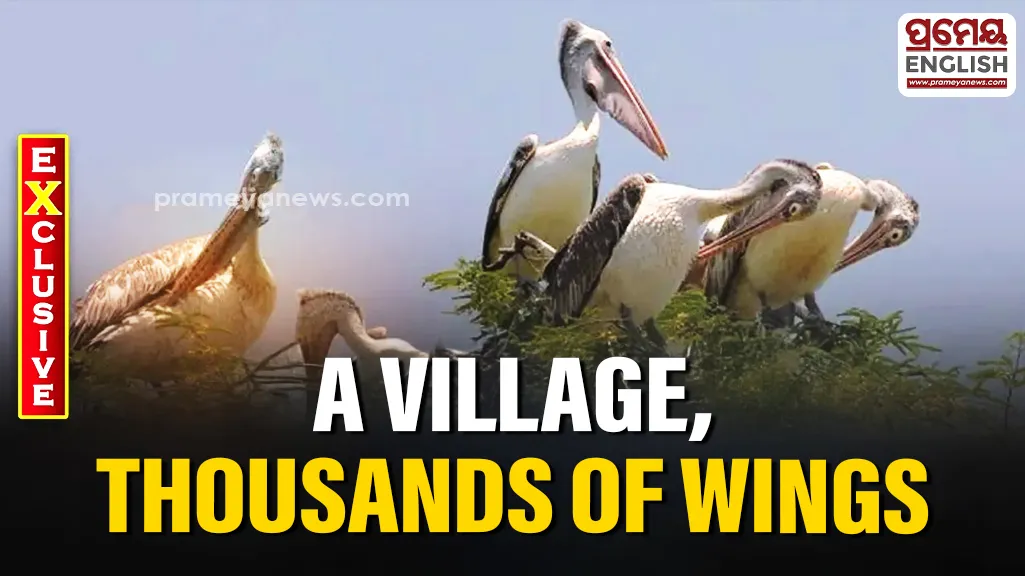
Nuapada. July 20: As the first signs of summer fade and the season of rain approaches, the quiet village of Sonbarsa in Nuapada district comes alive with the arrival of its most cherished visitors. Every year around Akshaya Tritiya, before the monsoon clouds gather, a lone bird arrives to survey the surroundings. Soon after, flocks of migratory birds follow, transforming the small village into a vibrant sanctuary filled with their calls and movements.
Located in Sinapali block under the Singjhar Panchayat, Sonbarsa is home to nearly 100 families and around 800 people. Though small in size, the village has earned a special identity because of the thousands of foreign birds that visit it every year. The hundreds of tamarind trees spread across the village provide a perfect nesting ground for these seasonal guests.
A decade ago, the arrival of the Asian Openbill Stork changed the story of Sonbarsa forever. The birds came in groups and built their nests on tamarind trees, filling the village air with their distinctive calls. They also began frequenting the nearby Mulabasa Dam, where they searched for food and spent time in their natural surroundings.
What began as a seasonal visit soon became a bond between the birds and the villagers. As the number of birds increased, the people of Sonbarsa decided to take collective responsibility for their protection. Village meetings were held, a bird protection committee was formed, and strict rules were introduced to prevent hunting. Anyone found hunting birds faced a fine of ₹1,000. This community effort eventually made bird hunting a thing of the past in the village.
Today, the villagers consider these migratory birds not just visitors but a part of their own community. Before the birds arrive, preparations begin for their safety. Families take turns keeping watch over the nesting areas and ensuring that no harm comes to the birds or their young ones.
The birds usually stay in Sonbarsa for five to six months. During this period, they build nests, lay eggs, and raise their chicks. Once the young birds become strong enough to fly, the flocks return to their natural habitats around Diwali in October, leaving behind memories of their seasonal stay.
For the villagers, the arrival of these birds is also linked with nature’s rhythm. Members of the Bird Protection Committee, including president Gualu Raut and secretary Kundari Raut, believe that the arrival of the birds signals the beginning of rainfall and the start of agricultural activities. They say that when the birds return, farmers begin their cultivation, and when the birds leave, the rainy season gradually comes to an end.
This year, around 50 tamarind trees in the village have become nesting sites for the birds. Villagers such as Gosing Raut, Pundari Raut, Kaushalya Raut, and Kumar Raut believe these winged visitors are symbols of prosperity. To them, protecting the birds is not merely an environmental duty but a tradition and a responsibility passed down through generations.
Forest officials have also taken note of Sonbarsa’s unique relationship with migratory birds. According to Khariar DFO Aziz Khan, thousands of birds, including Asian Openbill Storks, Great Egrets, and Indian Pond Herons, have arrived this year. The Forest Department is monitoring their safety and conducting awareness programmes with villagers to strengthen conservation efforts.
In a world where natural habitats are shrinking, Sonbarsa stands as an inspiring example of community-led conservation. Here, a village has shown that protecting wildlife does not always require large projects—sometimes, it begins with a simple promise made by ordinary people to safeguard the guests who arrive on wings.