



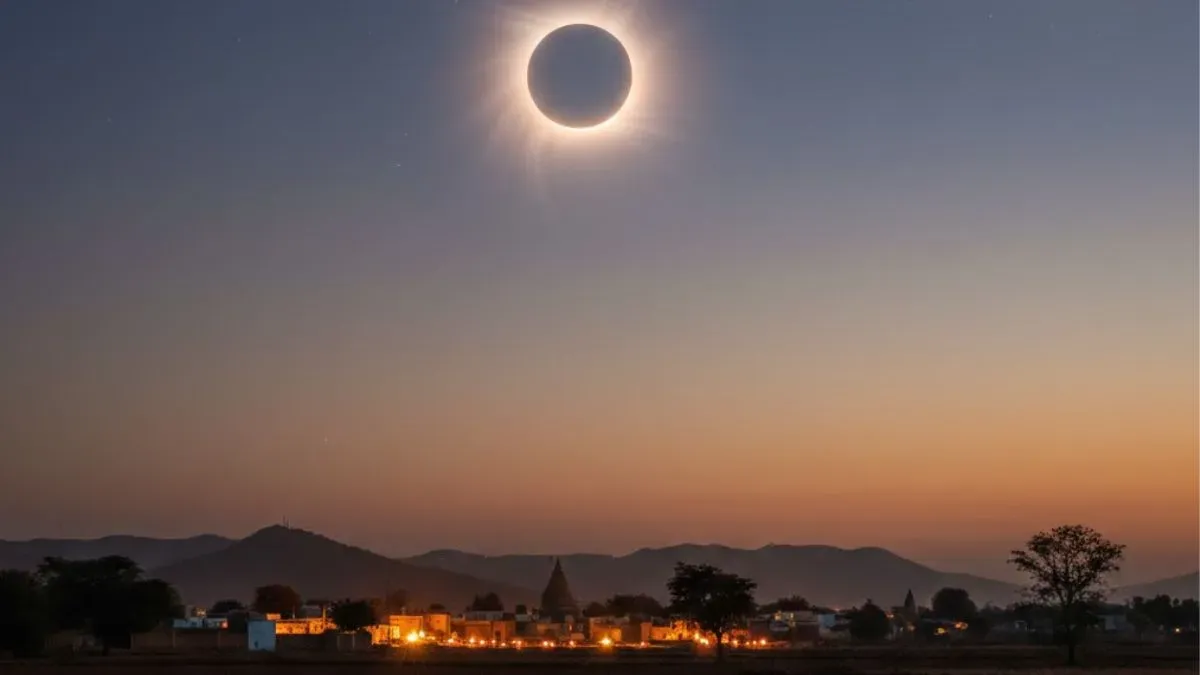
Puri, August 12: What happens when one of the most dramatic spectacles in the sky coincides with one of Odisha’s most sacred lunar observances? Wednesday, August 12, brings together a rare celestial phenomenon and Chitalagi Amavasya, creating a moment that is both astronomically fascinating and spiritually evocative.
A total solar eclipse will sweep across parts of Greenland, Iceland, northern Russia, Spain and a small area of Portugal. Several other regions across Europe, North America and Africa will witness a partial eclipse. NASA says totality will last less than two minutes for most observers, with some locations experiencing slightly longer darkness.
Yet, for devotees in Odisha, the significance lies not in witnessing the eclipse but in the extraordinary coincidence of the eclipse occurring on Amavasya, the new-moon day on which the sacred Chitalagi ritual is observed at the Shree Jagannath Temple.
Chitalagi Amavasya occupies a special place in the ritual calendar of Srimandir. On this day, the three presiding deities-Lord Jagannath, Lord Balabhadra and Devi Subhadra-are traditionally adorned with their precious Ratna Chitas, forehead ornaments embellished with valuable gemstones.
The Chitas, which are removed after Snana Purnima, are ceremonially restored during Chitalagi Amavasya. The glittering ornaments featuring precious stones such as diamonds, pearls, rubies and sapphires add an extraordinary splendour to the divine appearance of the deities. Previous Chitalagi observances have involved the Daitapati servitors performing the ritual after the completion of the scheduled Bhoga Mandap rituals.
For devotees, the moment carries a deeper symbolism: the Lord, emerging from the Anasara period and subsequent rituals of renewal, is once again adorned with the celestial-looking Chita—making the festival a visual expression of divine radiance.
Why does the Eclipse-Amavasya combination feel so magical?
An Amavasya already represents the darkest phase of the lunar cycle, when the Moon is not visibly illuminated from Earth. A total solar eclipse adds another extraordinary layer: the Moon moves directly between Earth and the Sun, temporarily blocking the Sun's visible disc.
Astronomically, the two phenomena are connected—the solar eclipse can occur only around a new moon. But culturally and spiritually, their convergence can appear especially powerful.
In traditional Hindu thought, Amavasya is associated with introspection, closure and spiritual observance, while eclipses have historically been regarded as unusual celestial moments associated with heightened ritual awareness.
The symbolism becomes striking:
Amavasya — the darkness of the lunar cycle.
Surya Grahan — the temporary disappearance of sunlight.
Chitalagi — the radiant return of divine ornamentation.
That contrast—from cosmic darkness to the brilliance of the Ratna Chita—gives this year's coincidence an almost poetic quality.
Will Puri witness the Eclipse? No-and that matters
Despite the global spectacle, India, including Odisha, will not witness the August 12 total solar eclipse. NASA's eclipse path places totality across Greenland, Iceland, northern Russia, Spain and a small part of Portugal, while partial phases will be visible across wider parts of Europe, Africa and North America.
Therefore, the eclipse itself does not create a visible astronomical event over Puri.
This distinction is important because religious practices at Srimandir are governed by the temple's established ritual traditions. Since the eclipse is not visible from Odisha, it does not automatically translate into an eclipse-related disruption of the temple's rituals.
Instead, Chitalagi Amavasya remains the central religious occasion at Srimandir, with the prescribed rituals and temporary restrictions on public darshan associated with the sacred ornamentation ceremony.