



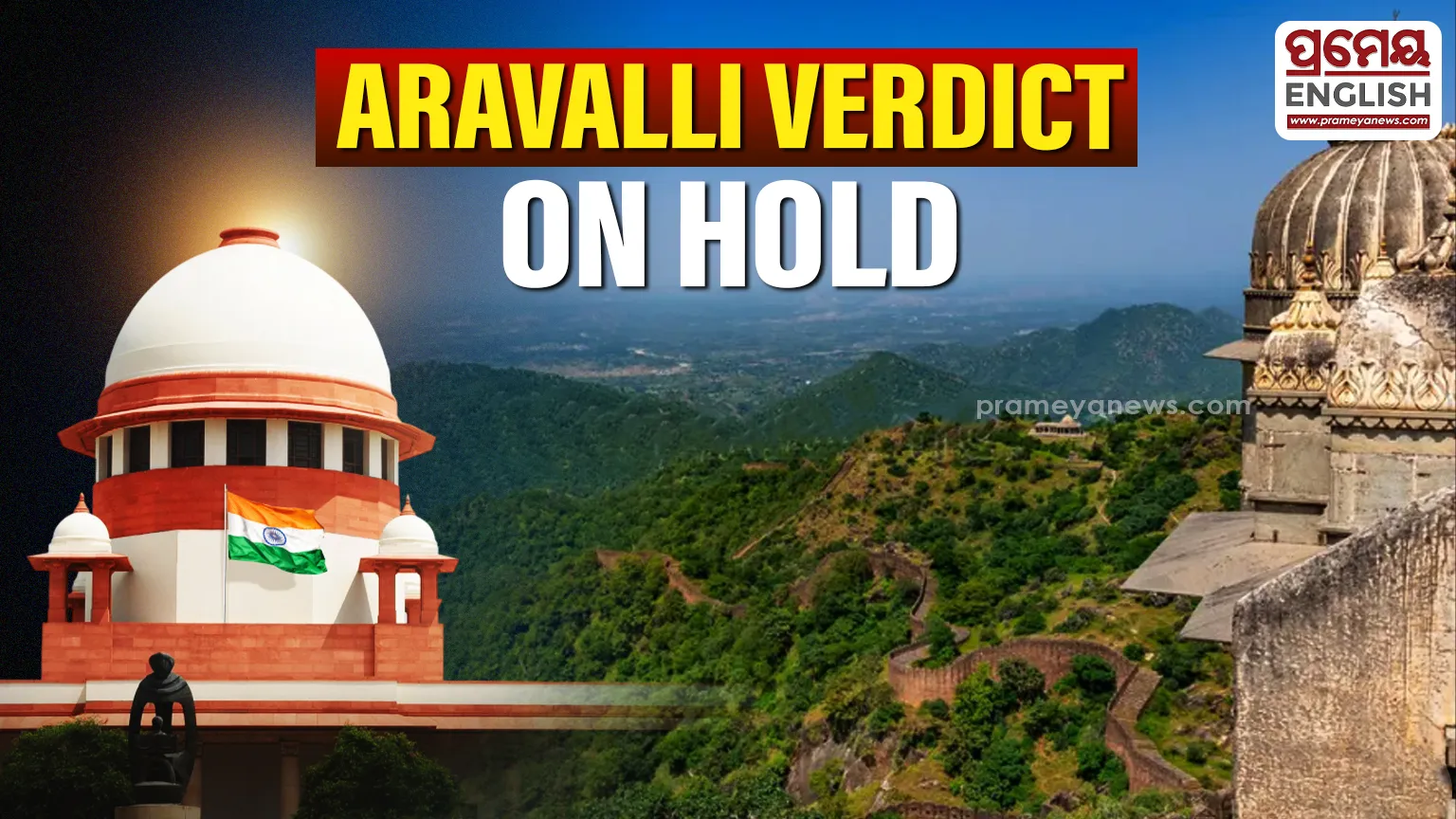
New Delhi, Dec 29: The Supreme Court on Monday put on hold the directions issued in its November 20 judgment that had endorsed a uniform definition of the Aravalli hills and ranges.
A vacation bench comprising Chief Justice Surya Kant and Justices J K Maheshwari and Augustine George Masih said it would consider setting up a high-powered committee of domain experts to conduct a comprehensive and holistic review of the issue.
“We deem it necessary to direct that the recommendations submitted by the committee, together with the findings and directions stipulated by this court in the judgment of November 20, 2025, be kept in abeyance,” the bench observed while hearing a suo motu case titled In Re: Definition of Aravalli Hills and Ranges and Ancillary Issues.
The court noted that certain aspects of the matter require further clarification. It issued notices to the Centre and other stakeholders and scheduled the case for further hearing on January 21.
In its November 20 ruling, the apex court had accepted a uniform definition of the Aravalli hills and ranges and imposed a ban on the grant of fresh mining leases in the Aravalli region spanning Delhi, Haryana, Rajasthan and Gujarat until expert reports were submitted.
The court had also approved the recommendations of a Ministry of Environment, Forest and Climate Change committee aimed at safeguarding the world’s oldest mountain system. The panel proposed that an “Aravalli Hill” be defined as any landform in designated Aravalli districts rising 100 metres or more above the local relief. An “Aravalli Range” was defined as a cluster of two or more such hills located within 500 metres of one another.
According to the committee, the entire landform enclosed by the lowest contour line—along with the hill, its supporting slopes and associated landforms, regardless of gradient—would be considered part of the Aravalli Hills. For an Aravalli Range, the area between two or more qualifying hills, along with related features such as hillocks and slopes, would also be included.
The November 20 judgment, spanning 29 pages, arose from long-standing environmental litigation in the T N Godavarman Thirumulpad case. The court had accepted recommendations to prohibit mining in core or inviolate areas, with limited exceptions, and had also endorsed measures for sustainable mining and the prevention of illegal mining in the Aravalli region.
Meanwhile, the Indian National Congress welcomed the Supreme Court’s latest decision.
Congress leader Jairam Ramesh said the proposed redefinition of the Aravalli Hills, being pursued by the Modi government, required more detailed examination. He recalled that the redefinition had earlier been opposed by the Forest Survey of India, the Central Empowered Committee of the Supreme Court, and the court-appointed amicus curiae.