
.webp)


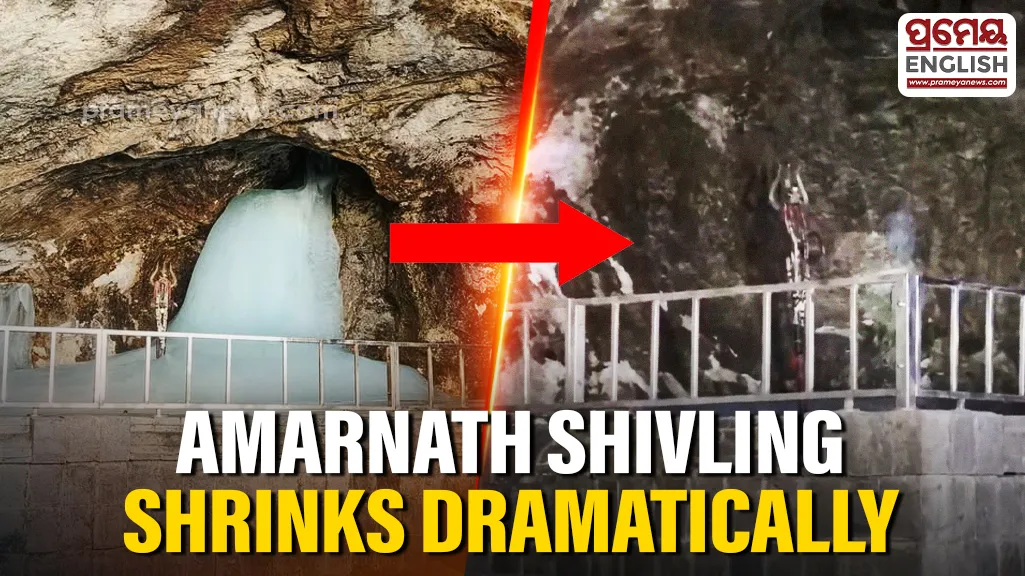
Srinagar, Jul 9: The naturally formed ice Shivling inside the holy Amarnath Cave has reportedly melted by nearly 90 per cent within just four days of the commencement of the Amarnath Yatra 2026, leaving thousands of devotees anxious as they continue their pilgrimage to the revered shrine.
Photographs from inside the cave, which surfaced on Monday, show the sacred ice formation revered as Baba Barfani reduced to only a small portion of its original size. The images have spread widely on social media, prompting concern among pilgrims, many of whom are still travelling to the shrine in the hope of obtaining darshan before the ice lingam disappears completely.
The annual pilgrimage began on July 3, with more than four lakh devotees registered for this year's Yatra. Since its inauguration, large numbers of pilgrims have been making their way to the cave, situated at an altitude of 3,880 metres in the Kashmir Himalayas.

The Amarnath Shivling is a naturally occurring ice stalagmite formed by the freezing of water droplets inside the cave during winter. Considered a sacred manifestation of Lord Shiva, the ice formation traditionally grows and recedes in harmony with seasonal weather patterns and has been worshipped by devotees for centuries.
The unusually rapid melting this year has raised fresh concerns. In previous years, the ice Shivling often remained intact through much of the pilgrimage season and occasionally reached heights of over 12 feet. However, this year the formation has shrunk dramatically within the first week of the Yatra.
Many pilgrims expressed disappointment and appealed for transparent updates on the condition of the sacred formation. Several devotees have urged authorities to undertake regular scientific monitoring so that pilgrims can receive accurate information before beginning the arduous journey.
Although officials have not issued a formal explanation for the accelerated melting, the development has renewed debate over the impact of rising temperatures and changing climatic conditions in the Himalayan region.
Climate experts have long cautioned that Himalayan glaciers and seasonal ice formations are increasingly vulnerable to global warming. According to specialists, unusually warm weather, changing wind patterns, and alterations in the cave's microclimate can significantly accelerate the melting of seasonal ice structures. Experts have recommended detailed scientific monitoring to distinguish between short-term weather variations and long-term climate trends.
This is not the first instance of the ice Shivling melting prematurely. In recent years, the sacred formation has repeatedly diminished well before the conclusion of the Yatra, a phenomenon that researchers say was uncommon a few decades ago. Environmental experts have previously recommended measures such as regulating pilgrim numbers, managing plastic waste, and reviewing the duration of the pilgrimage to help preserve the fragile ecosystem surrounding the shrine.
The Shri Amarnathji Shrine Board, which oversees the annual pilgrimage, continues to manage registration, logistics, and crowd movement, while security agencies remain deployed across transit camps and the pilgrimage routes to ensure the safety of devotees.
Despite the reduced size of the ice Shivling, thousands of pilgrims continue to undertake the sacred journey, hoping to offer prayers before Baba Barfani during this year's Amarnath Yatra.
.webp)