
.webp)


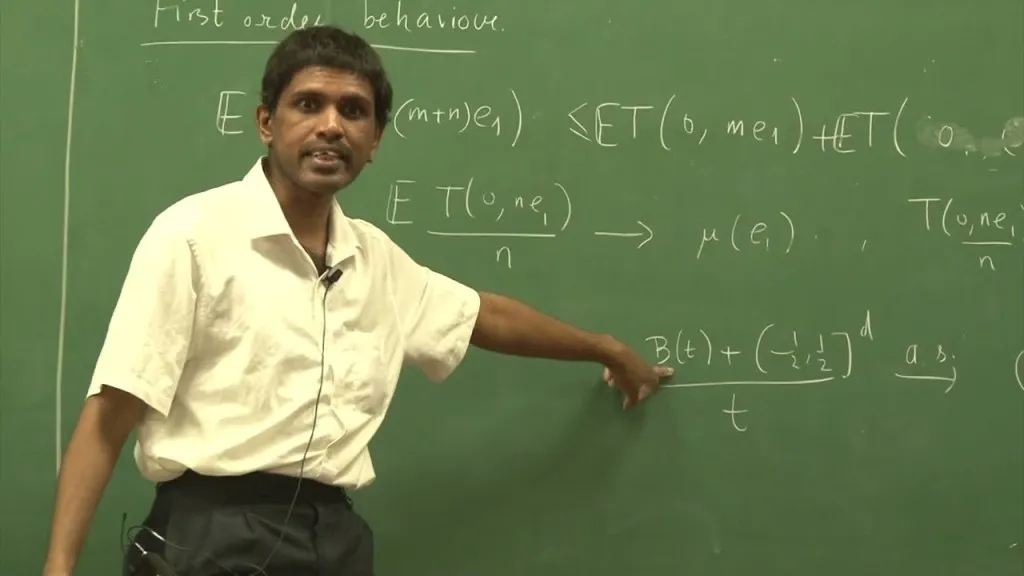
Riddhipratim Basu wins Infosys Prize 2026 for solving probability puzzle
Bengaluru-based mathematician Riddhipratim Basu has won the Infosys Prize 2026 in Mathematical Sciences for resolving a decades-old puzzle in probability theory and statistical physics. Serving as an associate professor at the International Centre for Theoretical Sciences (ICTS), a centre of the Tata Institute of Fundamental Research (TIFR), Basu received recognition from the Infosys Prize jury for methods that explain random growth, rare events, and complex interacting systems. His selection highlights how premier Indian research institutions like ISI Kolkata and TIFR continue to nurture global breakthroughs in fundamental mathematics while retaining leading scholars within the country.
Cracking the decades-old slow-bond puzzle
Central to Basu’s acclaimed research is his proof of the slow-bond problem, an open question that puzzled mathematicians and physicists for years. Researchers often explain this interacting particle model through a simple single-lane highway analogy where cars can only roll forward if the immediate spot ahead clears up. For decades, theorists debated whether slowing down just one tiny stretch of that road would reduce traffic flow along the entire lane. Working alongside mathematicians Vladas Sidoravicius and Allan Sly, Basu proved that even a minimal bottleneck at one isolated spot restricts movement across the whole system. He later teamed up with Sourav Sarkar and Allan Sly to verify Liggett’s theoretical model predicting how particle densities accumulate across both sides of that restriction.
Scholarly Path from ISI Kolkata to Bengaluru
Basu built his strong quantitative foundation at the Indian Statistical Institute (ISI) in Kolkata, earning his Bachelor of Statistics in 2009 and Master of Statistics in 2011. He then moved to the United States to pursue doctoral studies at the University of California, Berkeley, where he completed his PhD in Statistics in 2015 under Allan Sly’s mentorship. Following a two-year stint at Stanford University as a Szego Assistant Professor, Basu returned home in 2017 to join ICTS-TIFR in Bengaluru.
Expanding research beyond one breakthrough
Basu’s scholarly output extends well past the slow-bond proof into percolation theory and extreme deviations in random systems. Together with Shirshendu Ganguly and Allan Sly, he established a key large deviations result for first-passage percolation models that resist exact formulaic solutions. He has also resolved longstanding conjectures on fluctuations and optimal path geometry in last-passage percolation, clarifying how random structures expand over time. Before claiming the Infosys Prize 2026, Basu collected several national honours, including the Ramanujan Fellowship in 2017, the INSA Medal for Young Scientists in 2020, and the NASI Young Scientist Platinum Jubilee Award in 2021. Elected a Fellow of the Indian Academy of Sciences in 2025, he continues to mentor young researchers and strengthen India’s mathematical community from Bengaluru.
.webp)