
.webp)


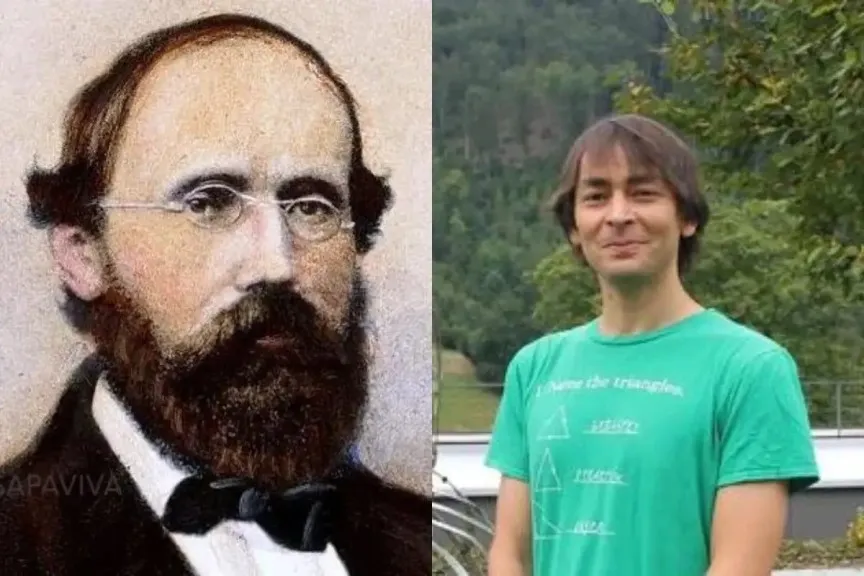
Mathematician claims Claude AI helped prove 167-year-old Riemann Hypothesis.
Mathematician Levent Alpöge, who works at artificial intelligence company Anthropic, announced on Friday that he and the firm's Claude model may have resolved the 167-year-old Riemann Hypothesis. In a personal website post, he stated that their shared method also extends to the broader Generalized Riemann Hypothesis. "I believe I have, working with Claude, discovered a proof of the Riemann Hypothesis," Alpöge wrote, as reported by Scientific American. Independent scholars have not yet verified the claim. Technology outlet OfficeChai noted that he published the Riemann Hypothesis proof across 14 sections written in Lean, a programming language that checks logical steps mechanically. Although formalisation is complete, he acknowledged the code is extraordinarily long and still lacks a readable paper for human peers.
Understanding the 1859 prime number puzzle
German mathematician Bernhard Riemann proposed this conjecture in 1859 to explain how prime numbers scatter along the number line. Primes, divisible solely by one and themselves, seem irregular yet follow deep patterns tied to the zeros of the Riemann zeta function. Riemann suggested that every non-trivial zero has a real part equal to one-half. Proving this rule would sharpen knowledge of prime distribution and resolve one of seven Millennium Prize Problems selected by the Clay Mathematics Institute, which offers a $1 million prize. As of Friday, the institute still listed the puzzle as unsolved.
How Claude contributed new number theory steps
Alpöge described the work as a collaboration where he guided strategy while Claude supplied vital breakthroughs. Their approach merged two number theory frameworks by adapting Stepanov's method, previously used for function fields, to ordinary number theory. To handle multiplicity in that setting, Claude suggested applying sequences of mathematical operations called theta lifts. "Tens of such occurred," Alpöge wrote regarding unexpected leaps from the model, adding that it significantly outpaced him near the end. He admitted several sections exceed his own expertise and require simplification for reviewers. Growing adoption of proof assistants like Lean reflects a broader shift in theoretical science, enabling researchers to audit intricate machine-generated logic line by line.
Recent milestones in machine-assisted mathematics
Friday's announcement follows months of rapid output from Alpöge and Anthropic's models. In August, Anthropic reported that an unreleased Claude version raised the lower bound for Riemann zeta zeros on the critical line from 41.6% to 67.2%, advancing a related problem without solving the full conjecture. In September, Scientific American also covered Alpöge's AI-assisted work on the 1947 Hopf problem concerning complex structures on a six-dimensional sphere, which mathematicians have started reconstructing and examining.
With inputs and image courtesy: Officechai.com
.webp)