



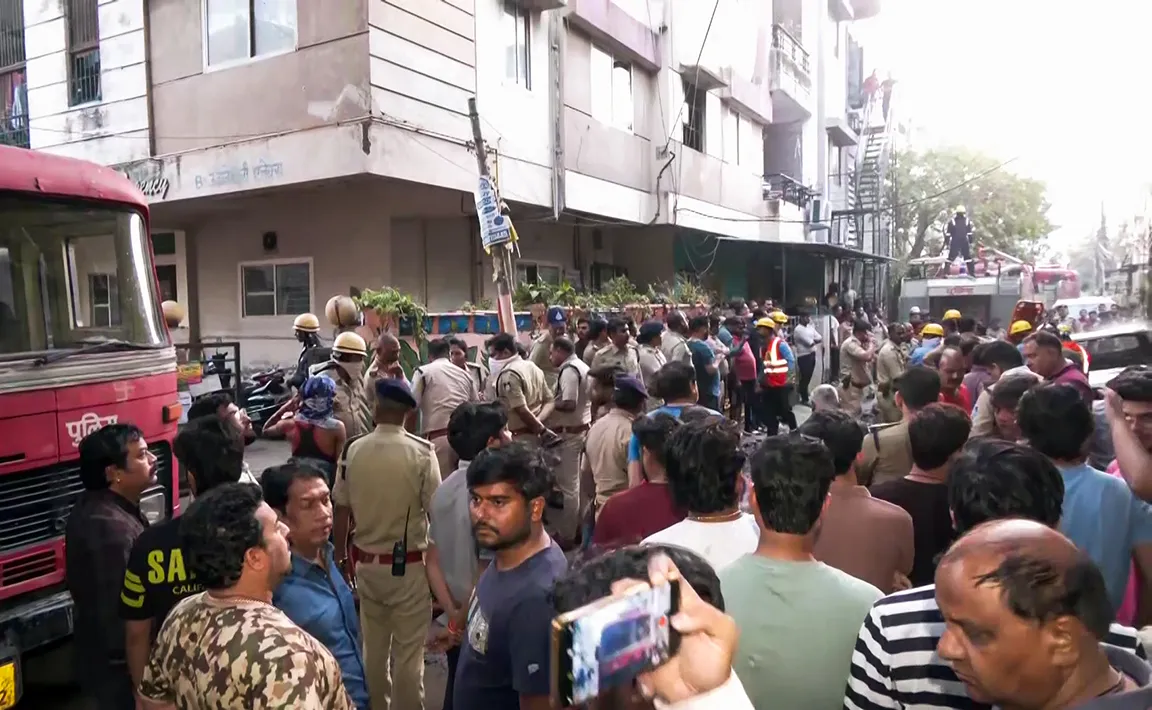
Indore (Madhya Pradesh) , March 18: The death toll in the fire incident that broke out in a tree-storey house situated in the Brijeshwari Annexe residential locality in Indore district has risen to eight, an official said.
The incident occurred in the early hours of Wednesday at around 4 am and spread rapidly. Commissioner of Police (Indore) Santosh Kumar Singh earlier informed Press about the chain of events that led to the incident. He said that it started from an EV charging point exploding while charging an electric vehicle, which was followed by explosions of "some" LGP cylinders.
MGM Medical College Dean Dr Arvind Ghanghoriya said that a total of eight bodies were brought for the postmortem, which was being conducted by a team of forensic experts and doctors.
"So far, we have received eight brought dead bodies which have been shifted to the mortuary for postmortem. The process of PM is underway and is being conducted by a team of forensic experts and doctors. All the bodies are burned, so it would take a bit longer time, and videography is also being done as a standard protocol for such cases. All precautions are being observed," Ghanghoriya told ANI.
"Seven of the deceased have been identified, which include Vijay Sethia (65 years), his son Chhotu Sethia (22 years), Vijay's wife Suman (60 years), Manoj (65 years), Simran (35 years), Rashi Sethia (12 years) and Teenu (35). The identity of the eighth person is being confirmed by the police, and details will be shared later," the dean said.
The postmortem process is underway, and it is expected to be completed within the next 2-3 hours, he added.
The fire incident occurred in a house situated in the Brijeshwari Annexe residential locality on early Wednesday morning at around 4 am. Upon receiving the information about the incident, the firefighters rushed to the spot and began the rescue operation.
Earlier, the Commissioner said that the fire tender team checked the nearby houses and buildings as a precaution because too much heat was generated at the time of the blaze.
"As per initial investigations, an electric vehicle was being charged outside the house, and the charging point exploded. After that, the fire then spread to the house from the car. We found that there were electronic locks in the building, so it seems that after the explosion, power cuts may occur and doors may be locked. It was a three-storey building, and more than 10 gas cylinders were also stored inside the house, some of which exploded. We also witnessed cylinder explosions between the time period of 4 am and 4:30 am," the Commissioner said.