


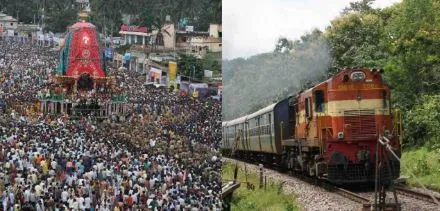
Bhubaneswar, July 29: East Coast Railway (ECoR) successfully managed train operations and passenger movement during Puri Rath Yatra-2026, ensuring smooth travel for nearly 13 lakh pilgrims despite incessant monsoon rains throughout the festival.
Puri Railway Station witnessed an average daily footfall of around one lakh passengers during the festival, with overall passenger traffic increasing by 6.78 per cent compared to last year's Rath Yatra.
Preparations for the annual festival began several months in advance, with ECoR drawing up a comprehensive action plan covering infrastructure, passenger amenities, security, surveillance, train operations and emergency response. The arrangements were reviewed regularly at divisional and zonal levels to ensure all measures were implemented on schedule.
The railway worked in close coordination with the district administration, Odisha Police, Shree Jagannath Temple authorities and other government agencies. Regular coordination meetings helped streamline crowd management both inside and outside Puri Railway Station, particularly during periods of heavy rainfall and peak passenger movement.
Various departments—including Commercial, Mechanical, Signal & Telecommunication, Electrical, Engineering, Medical, Railway Protection Force (RPF), Government Railway Police (GRP) and Housekeeping—were assigned specific responsibilities. A dedicated War Room monitored operations round the clock, enabling quick response to operational requirements.
To facilitate faster ticketing, passengers were encouraged to use digital platforms such as the RailOne App, Automatic Ticket Vending Machines (ATVMs) and Mobile Unreserved Ticketing System (MUTS) devices, significantly reducing queues at ticket counters. Passenger movement was monitored through a Command and Control Centre connected to 220 CCTV cameras and 19 video walls.
Based on real-time ticket sales and passenger demand, ECoR operated additional special trains and positioned extra rakes at strategic locations on the Khurda Road–Puri section for immediate deployment. Two Amrit Bharat Special trains were also introduced to handle the increased rush of devotees.
To protect passengers from the continuous rainfall, the railway created temporary holding areas covering over 16,000 square metres and rest shelters spanning more than 13,000 square metres. Additional passenger facilities included 187 temporary toilets, 128 bathrooms and 103 urinals, while housekeeping teams worked round the clock to maintain cleanliness.
Communication systems, including VHF sets, satellite phones and public announcement networks, remained operational throughout the festival. One Station One Product (OSOP) stalls run by ORMAS, KVIC and Self Help Groups promoted Odisha's traditional handloom and handicraft products.
Medical teams, first-aid booths and ambulances were deployed at Puri and other major stations. Around 13,000 pilgrims received medical assistance during the festival, including a critically ill young girl whose life was reportedly saved through timely treatment. Food safety and drinking water quality were monitored through regular inspections, chlorine testing, bacteriological sampling and laboratory analysis in line with FSSAI guidelines.
To ensure uninterrupted services, ECoR provided seven diesel generator sets, dual-source power supply arrangements, RCCB-protected circuits and UPS backup systems for essential facilities such as lighting and public address systems.
Security was strengthened through the deployment of RPF and GRP personnel supported by CCTV surveillance and AI-based monitoring systems. Security teams also helped trace missing children, recover lost belongings and prevent unlawful activities.
Ahead of the festival, ECoR completed several permanent infrastructure projects, including the commissioning of two new platforms at Puri Railway Station, an additional loop line at Malatipatpur, two Road Over Bridges replacing level crossings and expanded accommodation facilities at the Tourist Complex for pilgrims.
Beyond railway operations, ECoR extended support to other aspects of the festival. Railway personnel assisted in repositioning the three chariots on the Grand Road during the Suna Besha ritual using specialised carriage and wagon jack teams. In collaboration with NGOs, charitable organisations and corporate partners, nearly three lakh free meals were distributed to devotees. Railway officials also actively participated in coordination meetings organised by the Odisha Government to ensure seamless planning and execution of Rath Yatra arrangements.