
.webp)

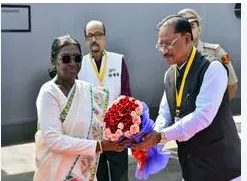
Jagdalpur (Chhattisgarh), October 23:President Droupadi Murmu on Friday attended the Muria Darbar, a historic tradition associated with the world-famous Bastar Dussehra festival, and urged tribal communities to preserve their customs and cultural heritage while adapting to changing times and ensuring quality education for their children.
Governor Ramen Deka, Chief Minister Vishnu Deo Sai and other dignitaries were present at the occasion.
Addressing the gathering, Murmu spoke about her tribal roots and praised the community for maintaining its traditions, cultural identity and spirit of harmony.
“I am also one of you. I am also the daughter of a Majhi. Even today, people in tribal communities live together in happiness and peace, dance and sing, and preserve their culture. I want to thank you all for keeping this culture and tradition alive,” she said.
The President said that the Constitution and tribal traditions shared the common goal of promoting peace, happiness and harmony in society. However, she described the traditional governance and dispute-resolution systems of tribal communities as particularly meaningful.
“The Constitution and republican rules have the same objective — happiness, peace and joy. We should live peacefully and with love, but the internal Constitution of tribal society is even more beautiful and meaningful,” she said.
Highlighting the traditional role of community leaders in resolving disputes, Murmu said that people had historically approached kings during festivals or when problems arose. Following the end of royal rule, villagers increasingly turned to traditional leaders, including the Majhi and Pargana, to settle local disputes.
She explained that when disagreements arose within families or over land, property or personal matters, the Majhi would convene a village meeting and help the parties reach a resolution.
The President encouraged people to make effective use of these community-based mechanisms to resolve local disputes and avoid prolonged legal proceedings wherever possible.
“Today, we are all educated. Do not waste your time going to police stations, police authorities and courts. These matters can take years, and sometimes two lives are lost in the process. Inform the Chief Minister or resolve the problem yourselves,” she said.
Murmu also stressed the importance of preserving traditional community gatherings and religious practices, noting that villagers prayed to their local deities for the welfare and prosperity of their communities.
“I request you to preserve this tradition and remain connected to your way of thinking,” she said.
Calling for unity in tackling the challenge posed by Naxalism, the President urged tribal communities not to be misled by Naxalites and emphasised the need for collective efforts.
“Naxalites sit outside and mislead us. We have to fight together — ‘if one person gets tired, then together we should carry the burden’,” she said.
Emphasising the need to balance cultural preservation with social progress, Murmu called on tribal communities to embrace changing perspectives without abandoning their traditions.
“Change your thinking with time, but do not change your traditions. Educate your children. The government is with you,” she said.
Her address at the Muria Darbar underscored the importance of safeguarding Bastar’s cultural heritage, strengthening traditional community institutions and promoting education as a means of empowering future generations.
.webp)