

.webp)


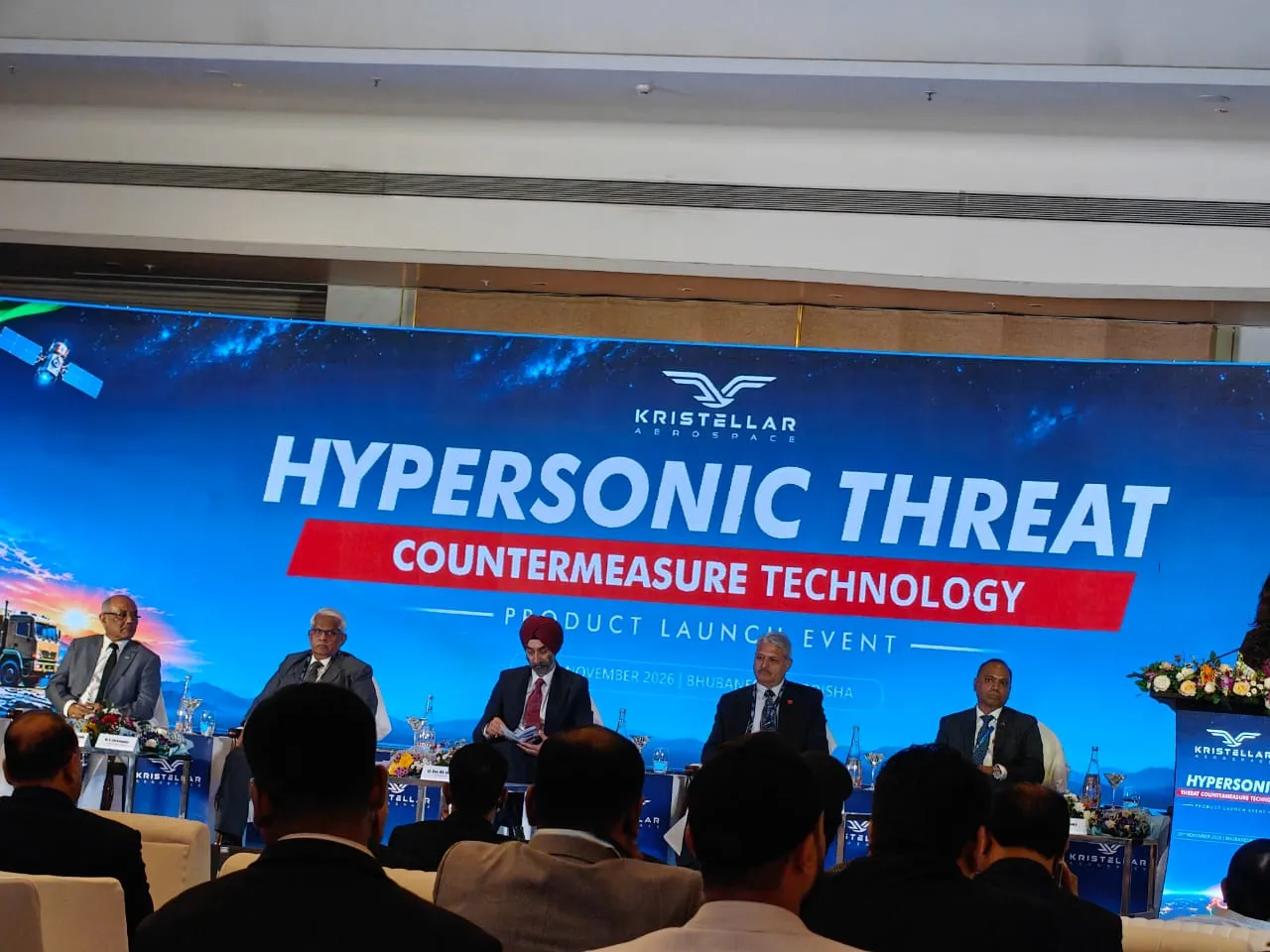
Bhubaneswar, Nov 20: Odisha took a step towards expanding its presence in advanced defence technology on Friday as Bhubaneswar-based Kristellar Aerospace unveiled its hypersonic countermeasure technology and announced proposed investments of Rs 1,350 crore in the state.
The proposals include a Rs 1,000-crore Space Technology Park and a Rs 350-crore project to upgrade its ORION DNN Lab into a quantum data centre and a facility for developing and manufacturing hypersonic countermeasure technology. Four agreements were signed during the programme, with EMS Ltd among the organisations associated with the signings. Ramveer Singh was also present. One of the agreements, identified by company founder Uday Bhanu Das, involved ADJ Engineering for setting up a quantum data centre.
Das outlined five milestones behind the company's development efforts, which began nearly five years ago. The first, and what he called its biggest achievement, is embedding artificial intelligence (AI) inference at the chip level to help radar systems process information and identify aerial threats faster.
The second is the development of the product itself, which Das described as ready for service in the coming months. The third is building a local talent base: the company currently has 54 young engineers and plans to induct several hundred more. The fourth is its effort to design and manufacture the technology in Odisha, despite the challenges of building a specialised manufacturing ecosystem in the state. The fifth is the proposed quantum datacentre with ADJ Engineering, which Das said would be made functional within nine months and serve Indian Railways, defence establishments and scientific institutions.
He also said Kristellar had designed a photonic radar architecture, which he described as functional, though he did not disclose further details.
What makes hypersonic threats difficult to counter?
Hypersonic weapons travel at speeds above Mach 5 and can manoeuvre during flight, making them difficult to detect, track and intercept. Countering them requires rapid processing of information from multiple sensors and timely decisions.
Kristellar says it is developing an integrated system combining ground-based sensors, high-altitude platforms and satellites in low Earth orbit. While the company says the ground and high-altitude components have been developed, the space-based component remains in progress.
Crucially, the system has not yet completed field trials. During the media interaction, company representatives said initial testing was planned at the Army Air Defence College in Gopalpur, followed by trials with the Northern Command. They also acknowledged that the algorithms designed to distinguish genuine aerial threats from decoys are yet to be experimentally validated.
Foreign chip dependence remains
The company's technology uses field-programmable gate arrays (FPGAs), semiconductor chips that can be configured for specialised processing applications such as radar and communications.
While Kristellar says its AI algorithms and encryption technology are developed in India, the FPGA hardware is supplied by US-based Altera. Das estimated that around 20% of the technology dependence remains external and said developing a comparable indigenous chip could take 10 to 12 years.
Altera's Senior Director of India Sales and Country Manager, Manoj Gopal Nair, said the company had no immediate plans to manufacture the same chips in India, citing technical and economic considerations. It would, however, support India through chip supplies and sharing technical knowledge.
State support under question
The announcement also brought attention to the challenges of building a defence technology ecosystem in Odisha. Brigadier (Dr) L.C. Patnaik, President, Defence and Aerospace at Kristellar, said the company had not received the level of state government support it had expected.
“The government support so far has not been as much as one actually expected. But we are optimistic about it,” he said.
Patnaik cited a manufacturing unit of around 20,000 square feet at Info City-II in Bhubaneswar and an assurance of around 10 acres at the Special Economic Zone in Gopalpur for the proposed space and defence park. He said support from central government defence establishments and the armed forces had been encouraging.
Air Marshal Surat Singh (Retd), meanwhile, stressed the importance of domestic defence capabilities, saying the sustenance of a war effort would rely heavily on local resources. He argued that self-reliance in defence was essential, particularly during prolonged conflicts when external supply chains could become uncertain.
Kristellar says it will prioritise India's domestic requirements before considering exports. The company's immediate challenge is to complete field trials and demonstrate that its technology can perform under operational conditions. For Odisha, the larger test will be whether the proposed investments translate into a sustainable ecosystem for defence research, skilled employment and manufacturing.
.webp)