


Bhubaneswar, June 8: The Odisha government has rolled out the National Education Policy (NEP)-2020 in schools across the state, introducing a revised curriculum framework and a new academic timetable aimed at reducing students’ academic burden and promoting experiential learning.
Based on the Odisha Curriculum Framework–School Education 2025, textbooks have been revised and teaching-learning activities will now be aligned with NEP-2020 guidelines. The School and Mass Education Department has issued detailed instructions to all District Education Officers regarding the implementation of the new academic structure.
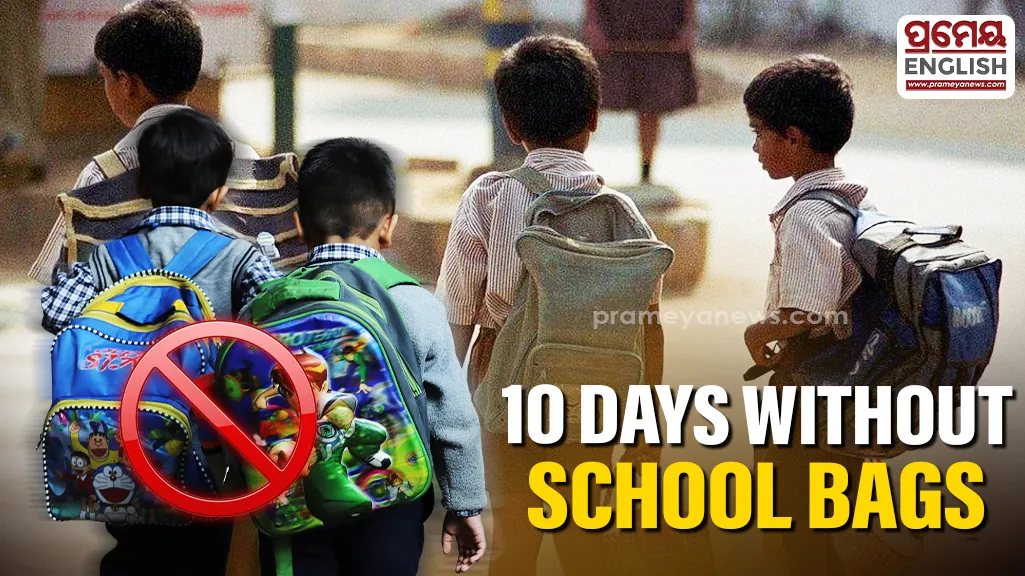
As per the new schedule, schools will remain open for 230 days in an academic year. Of these, 20 days will be set aside for formative and summative assessments and related activities, while another 20 days will be earmarked for annual functions, sports meets and other co-curricular events. Students will also observe 10 bagless days every year. After accounting for these activities, teaching-learning will be conducted for 190 days annually.
The department has introduced bagless learning days for students of Classes VI to VIII. One of the four vocational education periods will be designated as a bagless learning session, preferably on Saturdays.
To ensure better classroom engagement, all schools will follow a seven-period daily schedule, with 42 periods per week for all classes. Separate timetables have been prepared for students from Sishu Vatika to Class VIII, which schools will be required to implement.
In line with NEP-2020, greater emphasis has been placed on art and physical education. Both subjects will include theory and practical components. The department has also introduced double periods of 80 to 90 minutes for Mathematics, Science, Art Education and Physical/Vocational Education to facilitate project work, science experiments, presentations and activity-based learning.
Special provisions have been made for early childhood education. Sishu Vatika students will participate in a daily 15-minute circle-time session involving storytelling, poetry recitation, oral games and free interaction with teachers. Weekly Sishu Sabha programmes will also be organised every Saturday, featuring debates, quizzes, speeches, drama, creative writing and cultural activities.
The revised framework further focuses on strengthening reading habits through regular library sessions. Language classes for younger students will emphasise oral communication, reading and writing skills, while pre-reading and pre-writing activities will be conducted for Sishu Vatika children.
Mathematics learning at the foundational level will involve hands-on activities using real-life objects. Environment-based learning, free play, art activities and creativity development have also been incorporated into the curriculum as part of the state’s transition to the NEP-2020 model.