
.webp)


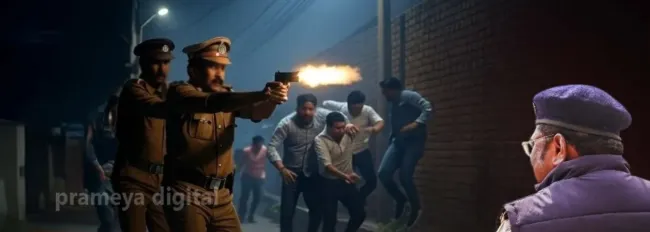
Bhubaneswar, May 28: Alleged criminal Papun Majhi was reportedly transporting drugs near Arisal Chhak on the outskirts of Bhubaneswar when he was intercepted by the Commissionerate Police’s Special Crime Unit, late on the night of May 26.
According to police, Papun opened fire while attempting to escape, forcing officers to retaliate in self-defence. A bullet struck his leg, and he is currently undergoing treatment at a hospital. In media terminology, the incident was described as another “encounter.”
Over the past six months, at least 10 alleged criminals across six districts of Odisha have sustained bullet injuries in similar police encounters. On May 25 alone, three separate encounters were reported in Ganjam district and Berhampur within a span of 24 hours. In one case, an accused identified as Jagannath Sahu alias Jaga allegedly hurled bombs at police while trying to flee. Police responded with gunfire, injuring both his knees.
In another incident, four murder accused brought from Rajasthan allegedly attacked police near Ankushpur in Berhampur while attempting to escape custody. Police fired in retaliation, injuring two of them in the legs. Media reports termed it “three encounters in a single day.”
A similar pattern was seen on December 16, 2025, near Charampa in Bhadrak district.
Acting on intelligence inputs, a six-member police team chased an alleged criminal named Budhia, who was reportedly travelling on a motorcycle. Police claimed Budhia opened fire first, prompting retaliatory firing in self-defence. He too suffered a bullet injury to the leg, while his associate escaped on an unregistered bike.
While police maintain that these encounters are acts of self-defence, observers point out striking similarities in most such incidents over the years. Nearly all encounters reportedly occur late at night or before dawn, and in most cases, bullets hit the accused in the leg-particularly the left leg.
According to unofficial observations, nearly 80 percent of encounter injuries involve the left leg, with only a few cases affecting the right.
This recurring pattern has sparked debate among human rights activists and legal observers. Questions are frequently raised about how police consistently manage to shoot only the legs of accused persons without causing fatal injuries or sustaining serious injuries themselves.
There have, however, been exceptions. In December 2018, alleged criminal Babu Nayak was shot in the leg, hand, and torso during an encounter in Bhanjanagar and later died due to excessive bleeding. Similarly, notorious criminals Lambu Tarini and Asta Mandal reportedly suffered severe leg injuries in separate encounters conducted by Ganjam and Berhampur police.
One of the rare daylight encounters in Odisha occurred in July 2021 when gangster Hyder allegedly attempted to snatch a firearm and escape while being shifted to Baripada jail. Police opened fire near Simulia, killing him on the spot.
Data suggests that encounter incidents in Odisha have increased significantly in recent years. While only four such incidents were reported in 2004, the number reportedly rose to 19 in 2025. This year alone, 10 alleged criminals have already sustained bullet injuries. Seven encounters were reported in May itself—four in Berhampur, two in Sambalpur, and one in Jharsuguda. Similar incidents were also reported earlier this year in Keonjhar, Pipili, and Sambalpur.
The growing frequency of encounters has also raised questions about police firearms training and shooting accuracy. Officially, all police personnel are required to undergo annual firing range practice as part of mandatory training linked to promotions and increments. Commissionerate Police officers, for example, reportedly train at the Naraj firing range near Cuttack.
However, some officers privately admit that these exercises are often treated as routine formalities rather than serious skill assessments. Critics argue that despite limited evidence of advanced marksmanship training, police teams repeatedly manage to hit accused persons precisely in the legs during high-pressure situations.
Senior police officials reject allegations of staged encounters, insisting that the objective is never to kill but to immobilize suspects during self-defence operations. According to them, targeting the legs minimizes fatality risks while allowing police to control dangerous criminals.
Regardless of the controversy, encounter operations have increasingly become a prominent policing strategy in Odisha’s fight against organised crime.
.webp)