
.webp)



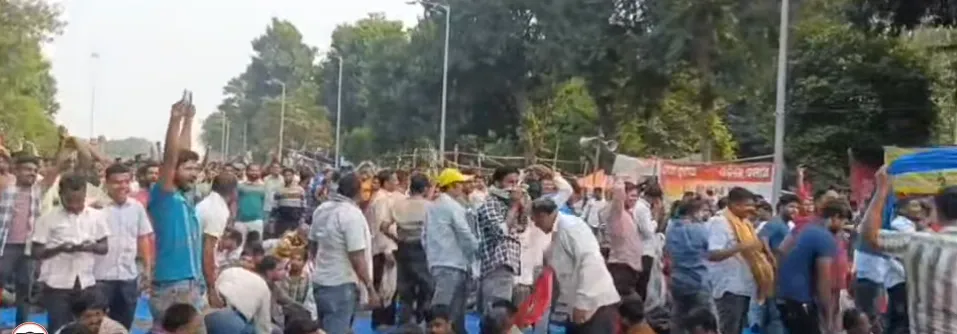
Bhubaneswar, November 26: The agitation by contractual electricity workers in Odisha entered its 57th day on Thursday, with protesters continuing their sit-in demonstration at Lower PMG in front of the Odisha Assembly, defying warnings from Deputy Chief Minister and Energy Minister KV Singh Deo.
Despite the minister’s assurance that no contractual worker would be retrenched from power distribution companies, the agitators remained firm on their demands, including the reinstatement of 192 customer care assistants disengaged in October 2025, job security, fair wages and a tripartite agreement involving the state government, Tata Power and the workers’ organisation.
On Wednesday, Singh Deo reiterated that not a single worker had been disengaged following the assurance given by Chief Minister Mohan Charan Majhi in May. He also warned that the government would not allow essential public services to be disrupted or held to ransom over what he described as unreasonable and illegal demands.
The minister further asserted in the Assembly that the government would take a firm stand against any attempt to disrupt essential electricity services.
 Meanwhile, the agitation took a serious turn on Wednesday when some protesters climbed high-voltage transmission towers at multiple locations in and around Bhubaneswar, prompting authorities to temporarily shut down power supply to avert possible accidents.
Police arrested three protesters after they climbed a live 33-KV transmission tower at Acharya Vihar Square. They were booked under various provisions of the Bharatiya Nyaya Sanhita (BNS) and the Essential Services Maintenance Act (ESMA).
The protesters, under the banner of the Odisha Bidyut Thika Karmachari Milita Manch, have been demanding the reinstatement of the 192 disengaged customer care assistants, besides employment security, better wages and a formal tripartite agreement to safeguard their interests.
With neither side showing signs of backing down, the prolonged agitation has raised concerns over the possibility of further disruption to electricity-related services in the state.
.webp)