



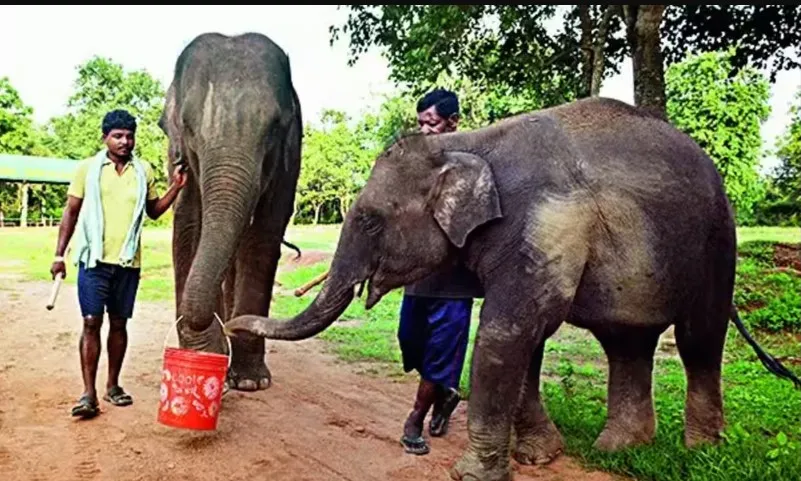
Bhubaneswar, August 12: Some were rescued after falling into ditches, some were pulled out of abandoned wells, while others survived accidents. But what they have in common is that they were eventually left behind by their mothers.
Despite repeated efforts by Forest Department personnel to reunite them with their mothers and herds, the attempts failed. Once the calves came into prolonged human contact, their mothers no longer accepted them.
Today, these seven motherless elephant calves from different parts of Odisha have found a new home—and a new family—at Kumarakhunti.
Located inside the Chandaka-Dampada Wildlife Sanctuary, the Elephant Rescue Centre at Kumarakhunti is popularly known as an “elephant school.” Here, rescued calves are not merely sheltered; they are trained, exercised, cared for and prepared for a future role in forest conservation.
Seven calves, seven stories
The seven elephants have arrived at the centre from different parts of the state.
Chandu, a male calf, was rescued from the Bargarh Forest Division on December 24, 2011. Kartik, another male calf, was rescued from the Athagarh forest on July 7, 2010.
Uma was rescued from the Sadangi forest range in Dhenkanal district on September 4, 2012. Seema was rescued from Panposh in Rourkela on October 14, 2024, while Radhika was rescued from Narla in Kalahandi on September 16, 2024.
Kanha was rescued from the Champua Range in Keonjhar on November 2, 2024. Jagannath, popularly known as Jaga, was found wandering alone in the Similipal landscape after being separated from his mother and herd.
Each has a different story of abandonment and rescue. But at Kumarakhunti, their stories converge.
A childhood away from the wild
Ranging in age from three to 15 years, the elephants now spend their days together. There is exercise, training, play and, of course, plenty of food.
The centre has facilities designed specifically for their care, including an Elephant Restaurant, where the calves are provided food according to their needs.
The routine is carefully structured. Regular physical exercise helps keep them fit, while various training programmes prepare them for their future responsibilities.
For elephants that once lost their mothers, the companionship of other calves has become an important part of their new life.
Training them to become ‘Kumkis’
The Forest Department has a larger purpose for these rescued elephants. They are being trained as kumkis—captive elephants trained to assist forest officials in managing and monitoring wild elephants and in various forest-protection operations.
Once their training is complete, they are expected to be deployed in different forests of Odisha.
Their responsibilities could include helping forest personnel drive away poachers and timber smugglers, assisting in operations involving wild elephants, and helping guide elephants that stray into human settlements back towards the forest.
They may also be used for carrying tourists on forest excursions, potentially generating additional revenue for the Forest Department.
A school with a purpose
The elephant school at Kumarakhunti began on March 6, 2024, with an ambitious vision: to transform abandoned and rescued elephant calves into trained companions for forest protection.
For these seven elephants, however, Kumarakhunti is more than a training centre.
It is where they have found food, care, companionship and a second chance at life.
They may have lost their mothers in the wild—but together, at the elephant school, they have found a herd of their own.